
TALK · summer camp of the ETS school: OPENIT 2026 · II/ STEADY · KELLER / TERESA OF ÁVILA / LAUBACH
The colourful world of prayer
The second workshop of a three-part series — this time about the heart. About the islands of God’s presence that the church talks about so much — and about the boats and bridges that lead to them.
“If somebody asked me what my greatest difficulty is in meeting these Moros [an illiterate Muslim tribe], I would have to answer: ‘No great difficulty — apart from staying spiritually ready.’ And I wonder whether that is not the only really serious difficulty there is — anywhere, in anything. This year I am readier than I have ever been, and perhaps that is exactly why the people seem readier too.”
Frank C. Laubach, Letters by a Modern Mystic, p. 30 — a missionary among the Muslim Moro people; his method taught 60 million people to read
Hard graft vs. dwelling in God’s presence
Timothy Keller planted a church in New York — a city full of successful people who are very demanding about the quality of content. He was blessed with an excellent memory, and nobody can deny the quality of his sermons.
At the same time he had to face competition from churches that drop the bar to the floor in order to win members: they do not teach about sin, they just encourage everybody with self-improvement sermons and try to be as positive as possible. That is why people thought he was out of his mind for wanting to plant a church precisely there. Right at the beginning of his book on prayer he describes the dilemma of two kinds of prayer.
The tough guys and the hard graft
On one side he talks about those for whom prayer is work and hard graft. You cannot serve without prayer, because the battle is fought primarily on the spiritual level — and so you pray for the kingdom of God to spread: for people, for ministries, for activities. You simply have to put in the hours on your knees.
But this side also has its extreme, the tough guys who say that the feeling of God’s absence is the norm you have to reckon with. And there are those, too, who sound sceptical about whether God will speak to us at all:
- The American theologian Austin Phelps opens his book on prayer, The Still Hour (1860), with the premise that for a praying Christian the sense of God’s absence is the norm, because most people find it hard to experience God’s presence at all.
- Donald Bloesch regards the Bible as a sufficient instrument through which God speaks to his people, without needing any other sources of revelation.
“I am firmly convinced that whoever does not believe it will never experience it for themselves, because God is not at all fond of having limits set on what he does.”
Teresa of Ávila: The Interior Castle, p. 35
Prayer as struggle and hard graft is in fact the dominant kind of prayer I knew in my younger years. There was not much about it that was pleasant, but we dutifully kept up prayer meetings in the youth group — and it has to be said that the praying did not stay without fruit and our youth group grew.
C. S. Lewis describes petitionary prayer as a good and necessary foundation. The struggles and the uncertainty about whether we are heard and whether our prayers will be answered refine our faith; they are a good foundation, and without it we should not venture into higher forms of prayer.
Listen to N. T. Wright:
“Prayer is part of a larger calling in which we human beings are to bring God’s love into the world. But if it does not start with prayer …, it can easily end up as nothing more than a version of our own interests, which we then hope God will rubber-stamp for us. And the answer to that is: he may, and he may not. All the work of the kingdom, all the work the good news does in the world, remains God’s work, even though he shares a considerable part of it with us.”
N. T. Wright: Simply Good News, pp. 120–131

Timothy Keller: Prayer — the book most of tonight’s quotations come from.
Mysticism and joining the two
At the other end of the spectrum stands mysticism — a glimpse into the depths, God’s touch, an encounter with God and his presence, in which a person suddenly comes to know God in a completely different way than through information.
At the far left edge you then get the caricatures and the wild excesses: someone proudly gazing into themselves in order to achieve their own deification with the help of a mantra and Zen Buddhism.
Keller does not really bother to make distinctions within the left half of the spectrum, and I think that is a bit of a shame. Teresa of Ávila, for instance — probably the greatest name in the history of prayer — criticises those extremes severely: she sees humility and a gaze fixed on Christ as the foundation, she does not lead anyone towards emptying the mind, and the prayer of the Discalced Carmelites is surprisingly close to prayer as Luther taught it.

The whole spectrum of the two kinds of prayer: on the left communion (resting in God’s love), on the right kingdom (urgent pleading that God’s will be done) — with figures of faith placed between the two poles.
Edwards’s vision of 1737
But there is one thing you cannot deny Keller: he is not blind to mysticism from the Protestant camp. He quotes Jonathan Edwards, the Puritan preacher.
Once… in the year 1737, during my spiritual contemplation and prayer, I had an extraordinary vision of the glory of the Son of God as the mediator between God and man, and of his wonderful, great, full, pure and sweet grace and love, and of his patient, gentle and selfless kindness… The person of Christ appeared to me in an unutterable excellence, so beyond describing that no thought or concept can take hold of it at all…
… and this state, as far as I am able to judge, lasted about an hour, and for most of that time it moved me to weep aloud; streams of tears poured from my eyes. I do not know how else to describe it than as a sense of the soul’s heat being released and smothered, a sense that the soul had turned to dust and that I was filled with Christ alone — that I love him with a holy and pure love, trust him, feed on him, serve him and follow him, and am perfectly sanctified and cleansed by his divine and heavenly purity.
Jonathan Edwards, quoted in Timothy Keller: Prayer, p. 56
The two have to be joined together
And then Keller brings it all beautifully together. After all, neither Martin Luther nor Calvin nor Augustine can really be placed at the right-hand edge — they do not fit into either camp. And he asks:
Why did such different approaches develop? Why did one of them focus on communion with God and the other on the coming of the “kingdom”? One explanation is that these approaches mirror the actual, immediate human experience people have while they pray. Some find that under normal circumstances they have no emotional response to God at all and that it is extremely hard for them to concentrate in prayer for longer than a few minutes. For others the experience of God’s presence and love is entirely ordinary and natural.
… Which approach is better? Is the highest form of prayer serene adoration or assertive petition? If we ask it like that, we are expecting an answer of the “either/or” kind — and that is a rather unlikely assumption.
Timothy Keller: Prayer, pp. 12–13
You don’t have to choose
And then he sums it all up. We are not being made to choose between a Christianity built on truth and doctrine and a life filled with spiritual experience — the two belong together. To make the point he brings in the Scottish theologian John Murray.
We are not being asked to choose between a Christian life grounded in truth and doctrine and a life filled with spiritual power and spiritual experience. These two aspects cannot be separated. I am not being asked to give up theology and go looking for “something more”, for experiences. My task is rather to ask the Holy Spirit to help me experience what I know theologically.
Timothy Keller: Prayer, pp. 28–29
It is essential to realise that part of the life of faith is an intelligent mysticism… a living union and fellowship with the exalted and ever-present Redeemer… (who) dwells in fellowship with his people with attentive love, and his people dwell with him…
A life of true faith cannot be a cold, impersonal assent. There has to be passion in it, and the warmth of love and fellowship, because fellowship with God is the crown and the summit of true religion.
John Murray, quoted in Timothy Keller: Prayer, pp. 28–29
STANDALONE PAGE
The whole spectrum from communion to kingdom — who stands where, and where the two extremes lie — has its own page on this site.
Longing for God’s presence
In my youth-group days that mystical part — the longing for God’s presence — did not really happen in prayer. It happened more at worship evenings and at various concerts. And honestly: we did not go there entirely in order to give praise to God. We went to watch out for God’s touch.
The friend God was spoiling
Let me tell you another story from my younger days. I had a friend from primary school. Afterwards we went to different grammar schools, but she was not happy at hers, so we arranged for her to transfer to mine. We often talked about God together, I invited her to the youth group — and she came to faith.
And God spoiled her badly, badly, with his nearness. Out of the blue I would get a text message saying she could not bear God’s presence any longer and that the Lord should please stop. And it was obvious that she was not making it up — you could genuinely see it on her.
I cannot say that I envied her. That word does not come close to describing how much my own unfulfilled longing for God’s touch hurt. I simply could not handle it. God was spoiling me in other ways at that time, I really had nothing to complain about — but this was genuinely my most sensitive spot — and her text messages kept stabbing right into it.
At first I tried to explain to her that messages like that really hurt and that she should not send them to me. So then she would write about something else — and still not manage to avoid mentioning something of the kind.
It went so far that I had to rename her contact to “Delete” — so that I would manage to delete her text before I read it. But so that she could still ring me: by then she was a youth leader, we saw each other several times a week for ministry and there was a lot we had to sort out.
The book I could not read
Do you know what would have helped me most at that time? A book by Teresa of Ávila. Except I could not read it, because the Catholic church calls her a saint — and Protestants do not read saints, obviously, because they are not idolaters, are they.
And it makes no difference at all that while God was calling Luther in Germany to reform his church, at that very moment a girl was born in Spain who had the strength to stand up to the way the monastic orders were run and who also went through hard times with the Inquisition and with the church authorities of her day.
I was the church librarian. Teresa was definitely not there — and I am afraid there was not much Luther there either…

Teresa of Ávila: The Interior Castle — the book I was missing back then.
We don’t know what to do with prayer
It seems to me that we evangelicals often do not really know what to do with prayer. And I do not have that impression because I want to judge anyone — I have it because many people say so themselves. They admit that for a long time their own experience of prayer was more theoretical than anything else.
- Tim Mackie from The Bible Project has a brilliant sermon about how he only started venturing into this territory a few years ago.
- Timothy Keller writes in his book that he used to preach about prayer but never really practised it much — and that his first source on prayer was a set of university lecture notes. When I got to that passage, I nearly put the book down. That would have been a shame.
C. S. Lewis in two attempts
And then there is C. S. Lewis. He tried to write a book on prayer ten years before his death, but he gave up. Towards the end of his life he took it up again — and differently: as letters to an imaginary old friend from his student days. That way he could stay a layman and not pose as a master of prayer.
In the second-to-last letter he wrote something you don't usually find in books about prayer.
“We keep talking about prayer and not a word about the practical problem — how tiring it is. … Prayer is tiring. An excuse to skip it is never unwelcome. Once it is over, you feel relieved, as if the rest of the day were a holiday. We put off starting. We are glad to finish. And while we pray — unlike when we are reading a novel or doing a crossword — the tiniest thing is enough to distract us. …
What is really disturbing is that it had to be put on the list of duties at all. After all, we believe we were made ‘to glorify God and enjoy him for ever’. And if the few — very few — minutes we now spend in contact with God are a burden rather than a delight, then what? If I were a Calvinist, that symptom would fill me with despair. What can be done for a rose bush that does not like producing roses? Or rather, what ought to be done with it?”
C. S. Lewis, the second-to-last letter to an imaginary friend

C. S. Lewis: Letters to Malcolm — a book on prayer written as letters to a friend.
STANDALONE PAGE
Lewis's thoughts on prayer are also worked up as a separate infographic.
About boats and bridges
One of the big frustrations of my years in the youth group was that everyone in church talked about mysterious islands full of treasure — and by those islands I mean God's presence — but we never talked about the boats and bridges that get you there.
Over and over we heard how amazing those islands are and how badly we need to visit them. But can I actually get there? Why haven't I got there yet? Is the problem in me? What are the means? All that is left is a feeling of unfulfilment and a hyped-up will to reach something you have no idea how to get to.
The questions I was left with
To put it quite concretely, this is what I mean:
- Can I pray or worship my way into God's presence?
- John writes that he is talking about what they really saw and touched. What about us? Are we “just” supposed to believe, or is it our task to touch the invisible? And only then are we ready to bear witness?
Authors who know those islands by name
So let me tell you about authors who:
- lived what they taught for decade after decade — and we have had their teaching available for centuries,
- and whose ministry left an utterly indelible mark on history.
And their testimony is surprisingly concrete. It goes roughly like this: look at the horizon — there are several islands out there. Some of them you can reach with the means you have; some you can't. With the more distant ones it is purely up to God whether he ever takes you there. But I'll give you the names of those islands — and try asking people you know whether and when God took them there.
A side note: Scot McKnight belongs in this line too.
STANDALONE PAGE
You'll find the names of those ‘islands’ and the routes to them drawn out in the infographics about prayer.
Lives of the saints, and Teresa of Ávila
Do you read the lives of the saints?
If not, you're missing out on a lot. They are seriously inspiring stories — and they are not as tidy as you would expect.
- Thomas Aquinas had a small army sent after him by his family to stop him entering the monastery: his own brothers, who were soldiers, kidnapped him and held him prisoner for over a year.
- Augustine fought faith tooth and nail. Despite his mother's prayers he spent years in the Manichaean sect, still back home in Africa. He left it in disgust, fled to Rome — and only came to Christ in Milan.
- Catherine of Siena cut off her hair just so her parents could not marry her off and she could give herself to God. Her parents were dead against it; she took up a harsh asceticism to come closer to God — and God changed her and equipped her so much that she was sent on difficult political negotiations. She really was a complete alien, in the best sense of the word. But the asceticism wrecked her health.
- The uneducated little Thérèse, Thérèse of Lisieux, became the third woman to be crowned with the title Doctor of the Church.
Another Doctor of the Church is Teresa of Ávila — and she is the heaviest calibre of faith. She is the one I want to stop at. But first let me tell you why.
Decades between the world and God
Teresa of Ávila was a reformer of women's convents. It bothered her that houses of prayer had turned into nothing but overcrowded dumping grounds for unmarried girls. That is really not the way to choose women who long to sink into prayer.
And she was not much better off herself — for decades she wavered in the convent between the world and God. She was thirty-nine when Christ's suffering suddenly struck her deep in the heart and she wept and begged for the strength to stop living so ungratefully. The second blow came through Augustine's Confessions.
The first convent of Discalced Carmelites
She began to take prayer and serving God seriously, and swept several other sisters along into that zeal. One of them suggested they could leave the convent and found their own — one that would really revolve around God and keep the original rule, that is, the original idea of what a convent should look like and how it should work.
That is how the first convent of Discalced Carmelites came about: a life of complete poverty and devotion to God. But also a life of joy — she primarily wanted women who were cheerful, clever and had sound judgement.
“God protect us from gloomy saints.”
Teresa of Ávila
Who really wrote The Interior Castle
She wrote The Interior Castle because her confessor made her do it. She wrote it for her sisters, so that they would learn to pray.
And if you are picturing some glossy plastic saint, picture instead the manager of twelve companies she founded and runs from a distance — thinking about building work, about getting enough food for everyone, about relationships at work. She is sixty-two and suffers from migraines and other bodily weaknesses.
On top of that, the kind of convents she left behind cause her plenty of hard moments: her earlier Book of Her Life ended up in the hands of the Inquisition after a denunciation. And through all of it she stands — or rather kneels — in prayer.
INTERACTIVE INFOGRAPHIC
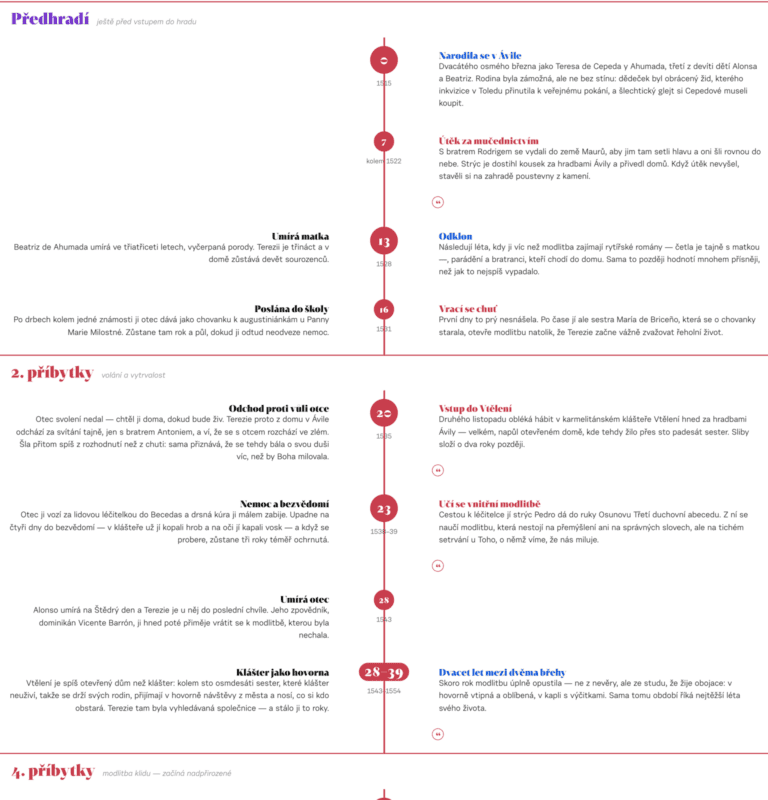
The life of Teresa of Ávila — the whole timeline from Ávila to Alba de Tormes.
The Interior Castle as a map of prayer
I told you about God's nearness as an island you have no real idea how to reach — where the only promising means is a worship evening or a concert. With Teresa you have a map in front of you for the first time.
- you know what the terrain looks like,
- what awaits you where, and what does not,
- how and where you can or cannot get.
First of all: prayer here is not an isolated event once a day. Your whole life is a prayer. The point is how you relate to God with your life. And it makes a fundamental difference whether you live a life that is foreign to God and then close your eyes at a worship evening and wait to be swept away — that is a completely mistaken expectation. Even though God can of course knock someone off their horse and blind them on whatever destructive road they happen to be on.
And you don't just know the map — you also see that a certain development is possible. I had never seen prayer that way before.
PREVIEW · INTERACTIVE INFOGRAPHIC

Seven mansions, the vermin in the outer courtyard, and the line beyond which the supernatural begins.
A castle of a single diamond
Teresa describes the soul as a castle made of a single diamond or of clear crystal. It is a large, sprawling and complicated place with a great many rooms. Our inner life is not a crumbling ruin — it is a beautiful but deserted place that can be filled by an encounter with God. God is there as the source of light; but it is true that by living in sin we can coat the castle walls in pitch, so that no light gets through.
The castle is beautiful because it is a dwelling built first of all for God to live in. And it has many different rooms — they are not simply arranged one after another; you can go up and down as well. Teresa gets worked up about how absurd it is that we do not really know ourselves from the inside at all. And that we voluntarily stay completely outside the castle where we could meet God: we live in the outer courtyard with all the vermin that clings to us. And yet the gateway in is obvious — it is prayer. And God lives in the very centre of the castle.
Whoever brings themselves to enter the first mansions goes in together with all that vermin — with the snakes, the lizards and the beasts.
- The snakes stand for money, the world, the desire to be successful.
- The lizards are all the small thoughts and images that clutter up your head like weeds.
- The beasts are appetites, passions and habits.
The three parts of prayer
And then there is the thing I was looking for longest: a concrete method, not just a description of the island. As prompts, Teresa herself reaches for books, or for works of art.
She divides prayer into three parts:
- picturing an image of the mysteries we are to meditate on,
- thinking those mysteries through with the mind,
- resting in God lovingly and attentively: that is when the fruit of meditation is gathered and the mind opens to divine light. You move from natural knowledge to supernatural knowledge when the soul gives itself over to this peaceful rest, loving and calm at the same time.
Teresa of Ávila, published by the Discalced Carmelites
A gradual development
Luther's way of praying is not that different — it too is built on reading Scripture, meditating on it, turning the text into prayer, and listening.
And then there is the development I mentioned. It doesn't start with euphoria, it starts with dryness — and that is normal. Keller describes it like this:
“At the beginning what usually prevails is a sense of spiritual poverty and of God's absence. The best guides through this period urge us not to give up, to hold on and to pray in a disciplined way until — as James Innell Packer puts it — duty carries us through into delight. … seasons of spiritual dryness can come back… we do not escape their returns until we break through a certain threshold and settle permanently into a sense of joy. Periods of a distinctly new orientation of the mind and of sensing God with the heart come more and more often, but every now and then they are interrupted, sometimes shockingly, by stretches of exhausting struggle, even by a sense that God is absent. And yet a dogged search for God in prayer does bear fruit in the end, because God wants to be honoured like this and comes to meet us (John 4:23) — and because prayer really does overflow with endless, astonishing riches.”
Timothy Keller: Prayer, p. 38
INTERACTIVE INFOGRAPHIC

Pilgrims' routes through the castle — how Augustine, Luther, Laubach and Keller moved through the mansions.
An answer to my hunger
Do you remember that hunger of mine? The friend God was spoiling with his nearness, and the contact I renamed Delete so that I could delete her text before I read it?
Here are the few lines I was missing back then.
It seems fitting to me that with frail women like myself — wretched and without any courage — God is not sparing with consolations. That is how he is dealing with me now. … But that servants of God, respectable men, very sensible and intelligent, should make a problem of it when God does not give them great devotion — that is something I find repugnant just to hear. Let them accept consolation if the Lord gives it, and value it. … But they should not fret if they do not have it. … if the Lord does not grant it, that means it is not necessary. Let them show a little self-control!
Teresa of Ávila, Discalced Carmelites, p. 223
Why I needed that back then
Because I was reading it the other way round: she gets those touches, I don't — so the fault must be in me. And Teresa takes that certainty away from me. When the Lord does not give consolation, it is not a verdict on my quality.
And now you
This is the moment when I switch roles in the youth group: now you teach me something about prayer. Tell me your tips: how you look for God and how you come closer to him. Over the years I have learned more this way than from many a book.
Teresa of Ávila — this quote comes from her writings too.
How often should we pray?
So how often should we pray? Once a week, once a day, twice a day, or all the time? Timothy Keller opens his chapter on frequency by first setting up the ideal — and that ideal is the maximum.
Paul urges us to “pray without ceasing” (1 Thess 5:17) — the whole day, everything with a conscious reference to God — “So whether you eat or drink, or whatever you do, do it all for the glory of God” (1 Cor 10:31). … The heart should get used to this kind of spontaneous prayer running on all day long — but we have to start with daily prayer.
Timothy Keller: Prayer
How many times a day?
But how to get to that ideal, Keller leaves fairly open. Instead he focuses on the bigger times of prayer during the day — and there, I think, he hedges a bit.
I had the places where different figures of faith sit on this scale drawn into an infographic — you'll find it on the right.
I am convinced that daily prayer should happen far more often than the classic evangelical schedule provides for. … I agree with most Protestant churches that twice a day is often enough. … Personally, morning and evening prayer suits me, but I also try to keep one short “stop” of focused prayer in the middle of the day, to remind myself of what I saw in the morning prayer.
Timothy Keller: Prayer, cf. p. 275
Start with something sensible
Notice the jump: we start at “pray without ceasing” and end up at twice a day. I don't want to hold that against Keller — he himself adds that short “stop” in the middle of the day to his morning and evening prayer, which is exactly the right direction. It just seems to me that in such a schedule the original ideal gets rather lost.
So yes, it is good to start with something sensible — once a day in the morning is fine. If you keep it up, that is a great foundation. I would just plead that you don't tick it off as done, and that you come back to God during the day as well with tiny prayers.
Who will take you further
Two guides will tell you the why and the how better than I can:
- Brother Lawrence and his book The Practice of the Presence of God.
- Frank Laubach — a slightly more modern author whose story is worth hearing.
INTERACTIVE INFOGRAPHIC

Frequency of prayer — how often the different figures of faith prayed.
Frank Laubach and the Game with Minutes
Sixty million people learned to read and write thanks to him. He was a missionary among illiterate Muslims in a remote part of the Philippines and he built a system by which such people could teach each other to read and write, so that literacy would spread further. That is probably why there is an American stamp with him on it.
A faith that was irresistible
He was well aware that the local imams had no reason to let him talk with people. So he decided to come so close to God and to settle so deeply into the kingdom of God that his faith would be irresistible to others. And it really worked — in the end the imams themselves sent locals to him when they wanted to know more about God.
Through all of it he sent letters to his father. They were later published as Letters by a Modern Mystic — they are very short and breathtaking, and they capture the reality of living in the kingdom of God brilliantly. Brother Lawrence describes the road to what he experienced with God, and it is very similar — but he does not go into describing the experience itself. Most mystics don't, and that leaves us much the poorer. Laubach did. This is how he describes what he was living through.
Day by day the sense grows in me that one invisible hand is holding me and leading me, while another invisible hand reaches out ahead and prepares the way. …
I am playing my part in a plan that goes far beyond me. This sense of working together with God in small things amazes me so much because I have never felt it like this before. I need something, I turn around and find it already waiting for me.
Of course I have to work, but God works together with me. Being aware of this gives me a sense of security and assurance for the future, which is also new to me.
It seems that I now have to care about only one thing, and everything else “takes care of itself” — or rather, and this is truer, God takes care of everything else. My task is to live this hour in constant inner conversation with God and in perfect responsiveness to his will. To fill this hour with God's glory. It seems that is the only thing I have to think about.
Frank Laubach: Letters by a Modern Mystic
The Game with Minutes
His main tool for coming closer to the kingdom of God was the Game with Minutes. He trained himself to turn his attention to God every single minute. It sounds unbelievable, but he really did write a booklet on how you can learn it.
It is a bit demanding. But what if you got used to turning your inner gaze to God for two seconds at every change of activity — or whenever it is at all possible? We often just rattle prayers off and never actually turn our attention to God in the whole prayer. This is the exact opposite. And in his letters Laubach reveals the results of his experiment.
The first step, the one I am trying to learn myself, is exactly this, and I have captured it in an infographic: filling every moment when an activity changes with a glance at God.
When I am fasting, I notice what feeds me more and when I feel more full. And the days I experienced quite differently were the ones when, during the fast, I did have the longer times of prayer, but kept coming back to God through the day in tiny moments — as often as I could.
INTERACTIVE INFOGRAPHIC

The Game with Minutes — a clock face with the moments when you can look up to God.

Frank Laubach: Letters by a Modern Mystic — letters to his father from the Philippines.
Silent written prayer
Let's try a different kind of prayer from the one you are probably used to.
First thing — let's kneel down. I don't know whether you normally do that or not, but we are about to come before the King, and whenever I take time to pray, I always kneel. We may call God the Father abba, daddy — but that does not mean we shouldn't come to him with respect.
Three very short prayers in silence
Pretty much every time I take time to pray, I start with this prayer — to realise who I am kneeling before and what I am. There will be three very short prayers and we will keep repeating them. Maybe you will say it is empty, meaningless mumbling — fine, in that case drop it and go your own way in prayer. But maybe these prayers will teach you the exact opposite: that it was rather all your prayers so far that were empty mumbling.
This is what they taught me: only when I say the prayer a second time do I really start to notice what I am saying. And only when I say it a third and a fourth time does it hit me that I have to aim my inner gaze at God. Has it ever happened to you that you recited a prayer and then realised you had just said something into the air? That the only things you were aware of were the people around you and whether you were praying properly? This prayer teaches the exact opposite. Pretty much every time I take time to pray, I start with this prayer — to realise who I am kneeling before and what I am.
Why in your head and not out loud
Don't say the prayer out loud now — say it inwardly. Why? Try answering how God usually speaks to you. Mostly in a quiet voice we have to learn to hear. So I said to myself: I'll turn my volume down to the level of the one I want to meet. And then I found out that this is mostly how C. S. Lewis prayed as well.
But the world of prayer is colourful — there is no single right way. A date isn't always the same either, after all.
How to prepare for a longer time of prayer
If you want to spend a longer time in prayer, it pays to prepare a bit. This sequence works for me:
- First I say a one-sentence prayer to God.
- I ask him to speak to me through God's word.
- Then I go and read Scripture.
- And only then do I go and pray.
Try putting worship music in your ears sometime, being before God and listening to the words they are singing. Or put on Lectio 365 and learn lectio divina — I'll play you a bit of it.
“The words are in any case secondary. They are only an anchor. Or, shall I say, they are the movements of a conductor's baton: not the music. They serve to canalise the worship, or penitence, or petition which might without them — such are our minds — spread into wide and shallow puddles. It does not matter very much who first put them together.”
C. S. Lewis: On prayer — Letters to Malcolm, p. 13
C. S. Lewis mostly prayed inwardly, not out loud — he writes about it in Letters to Malcolm.
Where to next
Almost every name mentioned here has its own infographic on the site — a map, a timeline or a chart. Here is the full index.
More infographics
 Prayer: The Interior CastleAfter Teresa of Ávila
 Prayer: The Game with MinutesAfter Frank C. Laubach
 Frequency of prayerAfter the pilgrims of the Interior Castle
 Two mentalities: Shalom vs. EmpireBased on the Bema podcast
 Chiasm: Treasure huntBased on the Bema podcast
 The kingdom of God: Map and timelineBased on the Bema podcast and MH
 Map of the disciplinesAfter Dallas Willard
 D. Willard: Renovation of the HeartBased on Renovation of the Heart
 D. Willard: Hearing GodBased on the book Hearing God
 Keller: Prayer — toil or delight?Based on the book Prayer
 C. S. Lewis on prayerBased on Letters to Malcolm
 N. T. Wright on prayerBased on the book The Lord and His Prayer
 The Minor Prophets: Twelve voicesBased on the Bema podcast
 The Gospels: Four voicesBased on the Bema podcast2×
 Seeking and strayingAfter the testimonies of ten pilgrims
 The quiet revivalBased on The Quiet Revival
 Groups of Jesus' dayBased on the Bema podcast
More talks