Meet the author of today's text. This is what the apostle Matthew looks like in the current series The Chosen. The series tells the story of Jesus and his disciples, and Matthew is one of its most striking characters.
After all, who wouldn't be intrigued by the story of a tax collector who was willing to collect taxes from his neighbours and fellow countrymen for the oppressors, the occupiers of their land — for Rome. Everyone despised him. Everyone — except Jesus, who thought it a good idea, of all people, to approach precisely him to follow him and become one of the disciples.
Yes, absurd as it sounds, a tax collector became a representative of the kingdom of God.
A demonstration of geometry
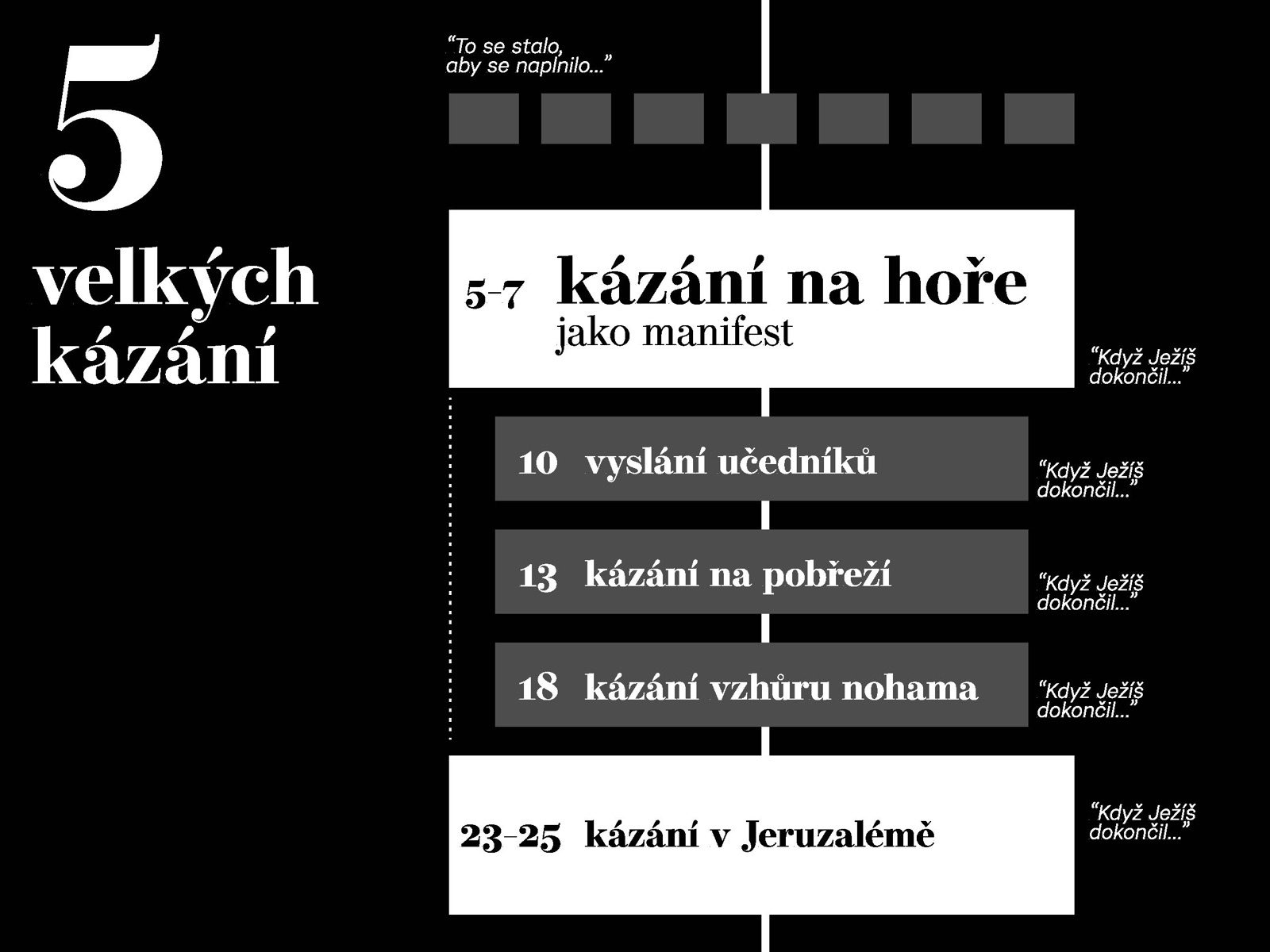
Any reader of his Gospel has to fall in love with Matthew, because he's simply brilliant. You can picture him in front of a detective's board, connecting individual events and people of the Old Testament with the life of Jesus with pieces of string. The result is a Gospel that resembles a perfectly symmetrical geometric figure.
At the beginning of his Gospel, the phrase “this took place to fulfil” appears 7 times — and because 7 is the number of fullness, he's clearly showing: see, Jesus fulfils all the prophecies about the Messiah.
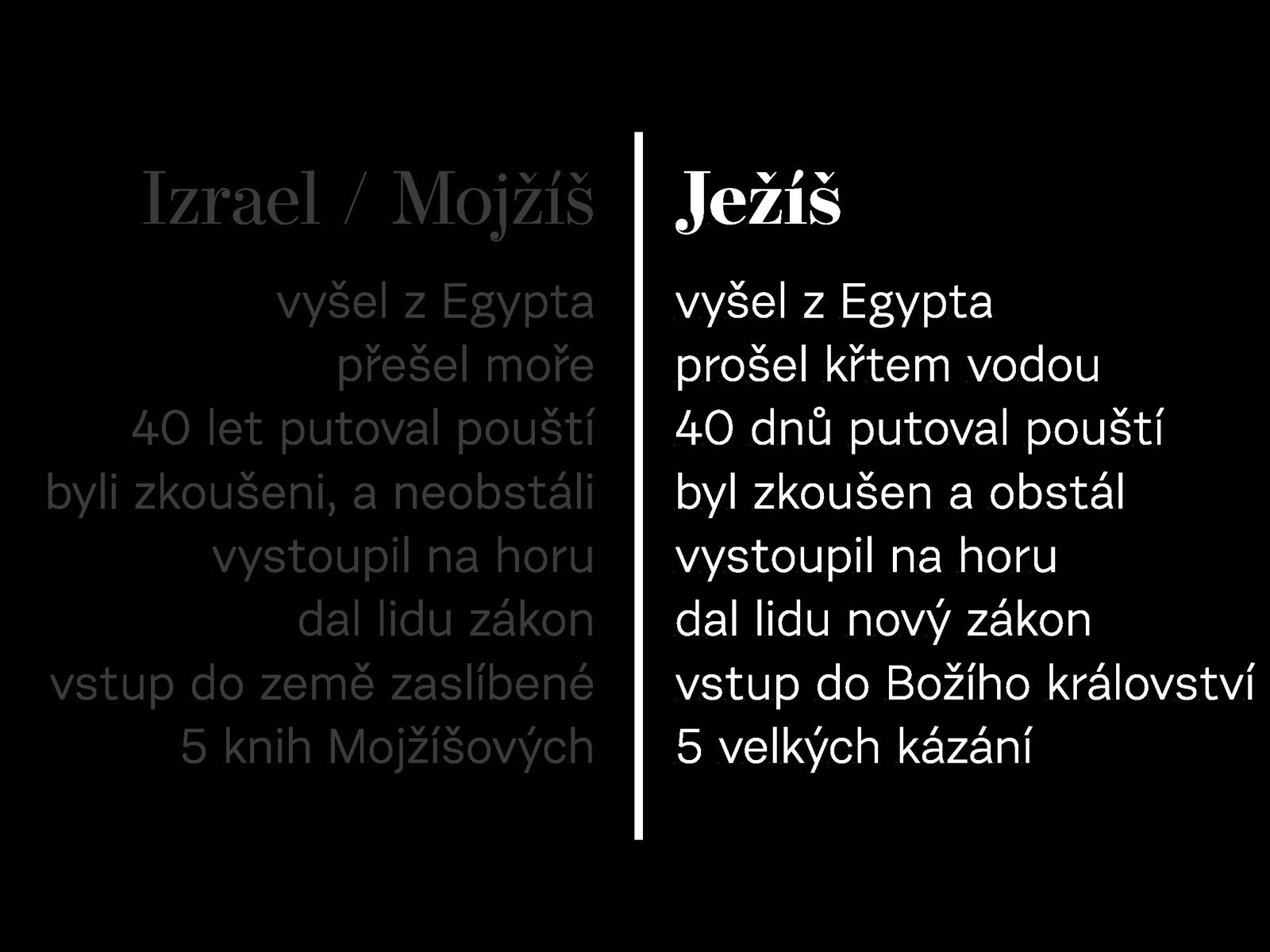
He arranges his narrative so that nobody misses the parallel with Moses:
Moses grew up in Egypt — likewise, Jesus spent part of his childhood in Egypt because of Herod, who was after his life.
Moses passed through the waters of the sea — and Jesus passed through the water of baptism.
Moses wandered in the desert for 40 years — Jesus wandered through the desert for 40 days during his fast.
Moses and the people of Israel were in the desert for a clear purpose — “to be tested” — and the same is written about Jesus, who, unlike his ancestors, passed the tests.
And now pay attention — this directly concerns our text: Moses went up the mountain and gave the people the Law — Jesus went up the mountain and gave the people the new Law. Moses led Israel to the promised land — Jesus leads the people into the kingdom of God. Moses is associated with five books — Matthew builds his whole narrative around five great sermons.
In short, Jesus is the new, greater Moses who will lead the people out of slavery.
And now the big announcement is coming. Jesus goes up to a raised spot so more people can hear him, grabs the microphone and proclaims his manifesto in his Sermon on the Mount: the kingdom of heaven is finally within reach — so you need to change the direction of your life. I'll tell you how the citizens of my kingdom are to live.
The structure of the Sermon on the Mount
Into three parts — introduction, main part and conclusion.
The main part is divided into three sections, and each of them is divided into three further subsections.
Three times three is nine — and there are nine Beatitudes too. “Boom” — mind blowing.
The Beatitudes
“Blessed are the poor in spirit, for theirs is the kingdom of heaven.”
Matthew 5:3
Blessed
I don't know if it's the same for you, but personally I struggle a lot with biblical terms that aren't used in everyday speech — I have to translate them in my head. And The Bible Project helps me a lot with that; for example, it renders “Blessed are you” as: “The good life belongs to…”
“The good life belongs to the poor in spirit, for theirs is the kingdom of heaven.”
Poor in spirit
OK — I don't know what poor in spirit means, but I find it offensive 🙂
I would feel extremely poor in spirit if someone pulled me out of my profession and put me, say, in a pharmacy — among those hundreds of unlabelled drawers full of medicines with utterly absurd names, made up of foreign substances I can't even pronounce, described in thick books where the simplest word is Popocatépetl.
And on top of that, the phone would ring from the hospital and a doctor would ask me, saying he needs to get such-and-such a medicine into a patient, but it's out of stock, and besides he's worried about such-and-such interactions, and they're not sure about the dosage… And I would know that the answer is perhaps somewhere in some book and in some drawer, but I'd apologise, saying that I'm not stupid, but I am poor in spirit: I don't have the necessary inner resources, I have neither experience nor knowledge, and so I'm completely helpless — I have nothing to offer, nothing to build on, I don't have what it takes to do what needs to be done.
And the disciples were in exactly the same situation. They had nothing at all to offer. They left their fishing nets or their tax booths… and suddenly Jesus gave them a new calling, and they have nothing to lean on. They can only hope in the one who called them.
Yes, there were professionals around too, but Jesus didn't go after them, he didn't choose them. The kingdom of heaven belongs to the poor in spirit. He didn't go to the Sadducees — those powerful religious elites; he doesn't even speak to the Pharisees — those seasoned and respected local preachers. Nor to the zealous, militant Zealots, nor to the Essene monks.
Wouldn't it be easier to build on the skills and zeal of these pros? Maybe — but Christ calls the helpless.
And then we see tax collectors and prostitutes bursting into the kingdom of heaven and, within moments, knowing more about love and forgiveness, about grace, than the learned Pharisees who stand nearby and want to kill Jesus.
Those who weep
Next he addresses “those who weep” — that is, those crushed by life, who have suffered a loss that really hurts. Hurts so much that it knocks you to the ground and you weep. That's who he's talking to.
And just as to the previous ones he says: “Blessed are you” — that is, “The good life belongs to those who weep.” What? Wait, what? Those who weep have the good life? So should we weep as much as possible too? Is it some ideal that Jesus is calling us to?
No — you've probably caught the trick by now: the “blessed are you” always refers to the second clause. So: those who weep don't have the good life because they weep, but because comfort is already in sight.
Likewise “the good life belongs to the helpless” — not because they are helpless, but because the kingdom of God belongs to them.
And so now we know how to read the third Beatitude:
The good life belongs to the meek, for they shall inherit the earth.
Matthew 5:5 (paraphrase)
The meek
“The meek” here means rather those who don't have a strong voice — they are “unimportant”, by the standards of this world they are “nobodies”.
But it's precisely they who are the heirs of God's kingdom — and that must have sounded almost explosive to them! Don't forget they live in occupied territory, and maybe it was their very field, which had belonged to their ancestors for dozens of generations, that had been forfeited to Rome in recent years.
And suddenly there's someone in front of them proclaiming a new kingdom — and they are the heirs.
Demands
Does he know his audience?
From the first three Beatitudes you can see that Jesus is very well aware of who his audience is. He knows who he's talking to: the poor in spirit, the helpless, the troubled, the unimportant, ordinary people with lots of worries.
Yes, on the one hand he encourages them — he proclaims a new kingdom, and in it there is room for all these people. They are the heirs of the new kingdom.
I'd hope
And I'd hope that, given those miserable people, the rest of the sermon would also be about lovely things that warm the heart: kittens and cuddly toys, flowers and little hearts, pink unicorns, fluffy puppies with big round eyes…
Let's skip a bit further in the text — but we're still only in the introduction:
A cold shower
Jesus continues:
11 Blessed are you when others revile you and persecute you and utter all kinds of evil against you falsely on my account. 12 Rejoice and be glad, for your reward is great in heaven, for so they persecuted the prophets who were before you.
Matthew 5:11–12
That's quite a cold shower — aren't we still in the introduction of the sermon? Shouldn't this be somewhere down at the bottom in small print, with an apology that it surely doesn't apply to everyone? They'll revile you and persecute you?
Do you know how they persecuted the prophets? Maybe you don't — but they had read Jeremiah and the other prophets. And this is supposed to be their fate?
Go into hiding
It doesn't have to be, right — because they can hide. They can keep quiet about following Jesus and nobody needs to find out, right… The next verses:
13 You are the salt of the earth, but if salt has lost its taste, how shall its saltiness be restored? It is no longer good for anything except to be thrown out and trampled under people's feet. 14 You are the light of the world. A city set on a hill cannot be hidden. 15 Nor do people light a lamp and put it under a basket, but on a stand, and it gives light to all in the house. 16 In the same way, let your light shine before others, so that they may see your good works and give glory to your Father who is in heaven.
Matthew 5:13–16
In other words
This world is full of decay and ruin — but you are salt: you hold back the decay. You are bearers of the covenant with God and you live differently — the difference shows immediately in your behaviour. You are just towards others and even merciful, you have a pure heart. Yes, it's dim all around and often even quite dark, but in you is the light of the New Covenant.
You're facing persecution, and purely in theory you could keep things quiet and hide — but that's nonsense, right: Can salt lose its saltiness? Then it wouldn't be salt any more. Can someone who follows Christ go unrecognised? It's clearly visible in their behaviour, after all. Can light stop shining? Well, then it wouldn't be light. Can Matyáš lose his Matyáš-ness? Well, that's nonsense — he wouldn't be Matyáš any more.
It's almost a little scary with what certainty and matter-of-factness he stresses that you simply recognise God's people.
Would you recognise a Martian if you met one? Well, of course you would — he's green, he's got little antennae on his head. Well, it's just as clear that you'd recognise a citizen of the kingdom of heaven. He's a bit like from another planet. Somehow he isn't that bothered by what happens to him here on earth, because his priorities and his life are hidden elsewhere. You can tell.
So what is Jesus saying right at the start of his sermon? Whoever follows me will be persecuted and oppressed, and will have a really big, bold target painted on their T-shirt so it's clear who to aim at.
He said this to people he had just described as helpless, without inner strength, weeping and troubled, ordinary, poor… He presents persecution as a well-paid job!!! Woooow!
Maslow
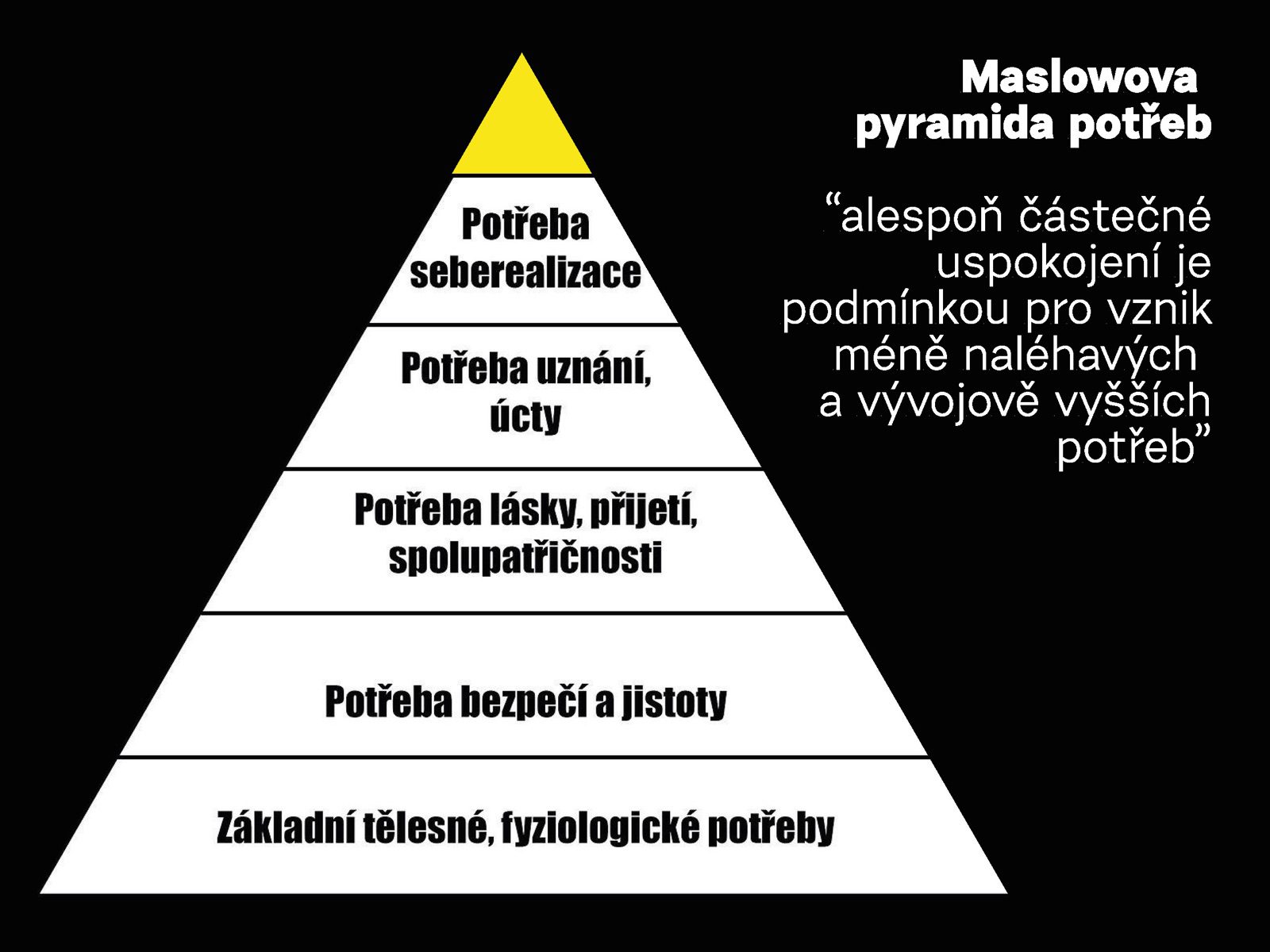
At secondary school and at university we learned about Maslow's hierarchy of needs — it's an abstract thing, but practical enough that I often think of it.
It's a ranking of needs from the most important and most essential to the more luxurious ones at the top. And you have to have the needs at the bottom at least somewhat covered before you can deal with the needs higher up. So first you need to have food and safety secured for yourself and your family before you feel like dealing with, say, the need to fulfil yourself in something.
Spiritual needs are right at the very top — they didn't even fit as text into that tiny little triangle. That's pure luxury for those who are retired, or have already fulfilled themselves in some career and don't know what to do with themselves — they can devote themselves fully to anything spiritual.
I realised that this is how I approach, say, the young people in the youth group — I tell myself: they're fighting on so many fronts, in so many areas they're still looking for their place — in relationships, in their own identity — and on top of that there's a dark cloud in their heads of all the gloomy thoughts and scenarios about an uncertain future… And so I caught myself thinking: there's no point loading anything more onto them and having high expectations of their enthusiasm for God and Scripture.
Here too, when I look out in front of me, I see plenty of people fighting on so many fronts — and surely I'm not going to be like a Pharisee and load onto you something I might not be able to carry myself. Some castles in the air… some kingdom of heaven…
But Jesus stood in front of people who were poorer, with far more basic insecurities — and he took Maslow's pyramid of needs and flipped it on its head. And he said: you can rejoice when hard things come. The main thing, what it's all about, is the kingdom of God. And you — focus above all on being the salt of the earth and the light of the world.
Conclusion
It's absurd that of all the passages in the Bible that call on us to follow Christ, it was this one that stopped me in my tracks — and only with it did I begin to understand how demanding Christ actually is. What he asks of a person. Only then did I realise that demands like these are in practically every speech he gives — so many of his parables speak in this same demanding spirit:
treasure: the kingdom of heaven as a treasure worth selling everything you have for (Mt 13)
father and mother: whoever loves father or mother more than me is not worthy of me (Mt 10)
career: where your treasure is, there your heart will be — so invest in the kingdom of God (Mt 6)
And it was only with Bonhoeffer that I found the words for just how demanding it is — words I'd been missing until then. He puts it like this:
Grace is free, but it is costly grace. It costs you your life.
Being cleansed from sin really is free and no one can earn it — but it is not cheap forgiveness. You then pay for it every day, for the rest of your life. Not that it's about repaying a debt to Christ — Christ doesn't want that at all, and it isn't possible anyway. The point is that once you have come to know Christ, it turns your priorities inside out.
The point is that from the moment you believed, you are no longer your own — a ransom was paid for you, and so you are to glorify God. The point is that only with salvation did you see the treasure, and it was so precious to you that you went and sold everything to get it. The point is that before deciding to follow, you were supposed to count the cost — because if anything were dearer to you, you are not worthy of Christ.
Grace is free, but it isn't cheap — it costs you your life.
after D. Bonhoeffer
Christ stood before all those powerless, worn-down people and said: I have good news for you, and a life of joy. But it's a road that by no means everyone wants to set out on. It isn't cheap grace.
He said: I know who is standing in front of me. I know you carry a lot of weight in your lives — but the reality of the kingdom of God is more real than this world, it is eternal, and so it takes priority. So each of you, take your Maslow's pyramid of needs and turn it upside down.
The opening of the Sermon on the Mount convicts me of one fundamental thing: if I were ever to get the impression that all that's asked of me is to conscientiously fulfil my roles, that's an embarrassing oversimplification. If I were to get the impression that everything is optional, that I don't have to strive for anything, that grace is free and nothing is expected of me — then I haven't understood Christ's grace. Because he himself speaks differently in so many places. The epistles speak differently too. The grace Christ offered is free, but it costs you your life.
That's exactly what the sources behind today's sermon deal with too: N. T. Wright, Dallas Willard, BibleProject, The Chosen. But I'll let someone else have the final word.
Bonhoeffer
I'll let Dietrich Bonhoeffer have the final word of the whole sermon. Let me remind you what kind of stuff this man was made of:
At the time Hitler was coming to power, he was working in London — but he didn't want to philosophise from a safe distance, so he went back to Germany, where he became one of the strong voices of the remnant of the church that stood up against Hitler. He prayed for the defeat of his own country, and the resistance eventually cost him his life.
Among other things he wrote a slim little book, Discipleship — it's beautiful, and I'll freely confess that I plain pinched it from a box that's been sitting in the storeroom for ages, and I refuse to give it back. So all I can do is hope those books were free for the taking — otherwise I'm in big trouble 🙂
The history of costly grace
persecution of the early church
the spread of Christianity (grace became the common property of the Christian world)
monasticism (it preserved the knowledge that grace is costly, that it involves discipleship — but discipleship as the extraordinary achievement of a few individuals)
Luther (a monk who went back among ordinary people and restored discipleship as the standard and the command for all Christians)
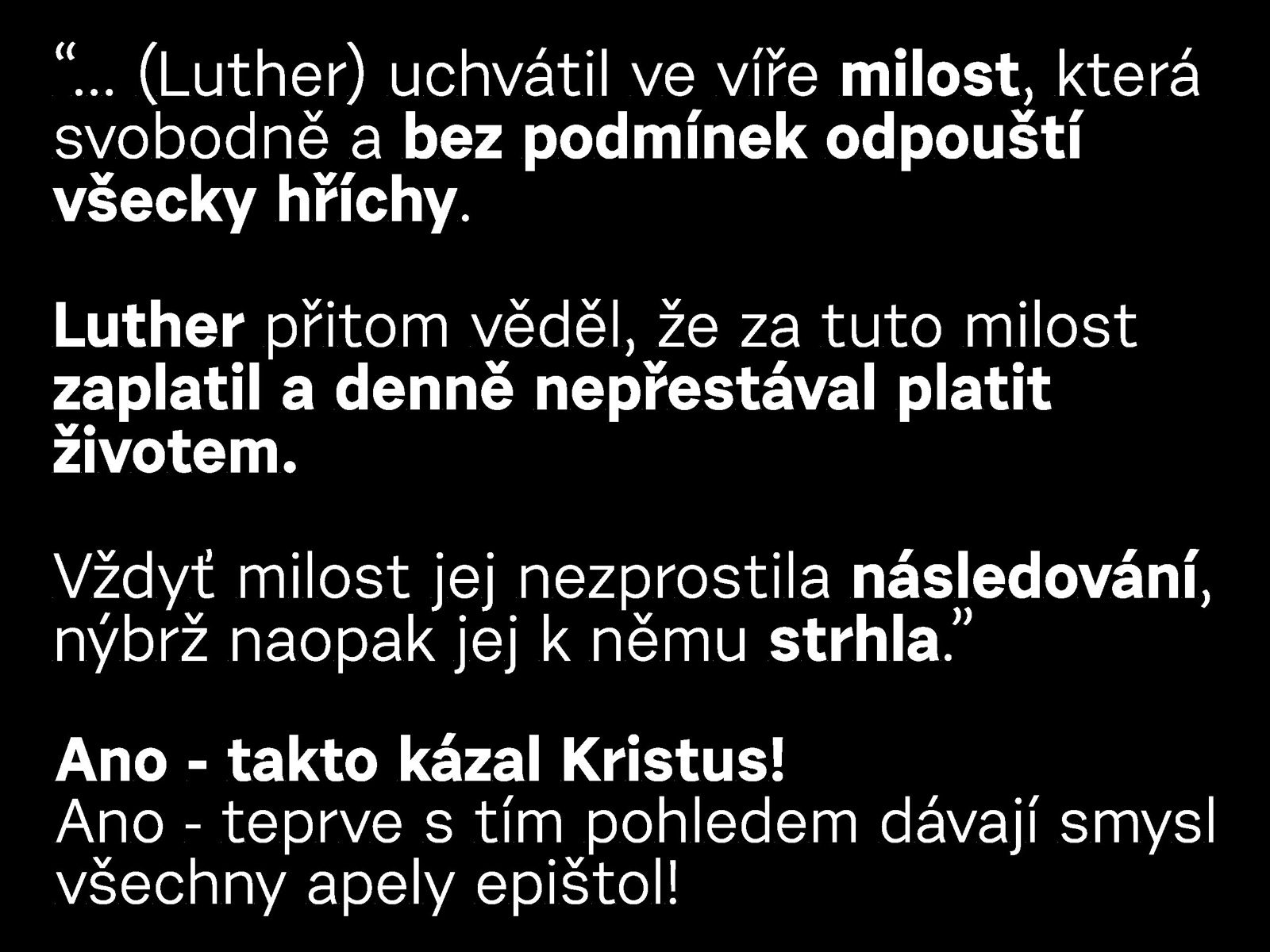
“… (Luther) grasped in faith the grace that freely and unconditionally forgives all sins. At the same time Luther knew that he had paid for this grace with his life, and never stopped paying for it daily. For grace had not released him from discipleship — on the contrary, it had swept him into it.”
Yes — this is how Christ preached! Yes — only with this view do all the appeals of the epistles make sense.
D. Bonhoeffer: Discipleship
Cheap vs. costly grace
A closing excerpt from Discipleship — you can download the whole longer text with the Bonhoeffer: excerpt (PDF) button at the top.
Cheap grace is the mortal enemy of our church. What we are fighting for today is costly grace.
Cheap grace means grace as goods sold off below cost, forgiveness squandered, comfort squandered. It means grace as the church's inexhaustible storehouse, from which we scatter it thoughtlessly and without limit, with careless hands. It is grace that has no price, that costs nothing. …
Cheap grace means the justification of sin, not of the sinner. … Cheap grace is grace without discipleship, grace without the cross, grace without the living Jesus Christ — the one for whom a disciple leaves his nets behind to follow him.
Costly grace is the gospel we have to keep searching for again and again, the gift we have to ask for, the door we have to knock on. It is costly because it calls us to discipleship — it is grace because it calls us to follow Jesus Christ. It is costly because it costs a person their life — it is grace because only through it do they gain life.
This grace is costly above all because it came at a high price to God, because it cost him the life of his Son — and because what is costly to God cannot be cheap for us. It is grace above all because to God his own Son was not too high a price for our life — yes, he gave him up for us. Costly grace is God becoming man.
Grace is costly because it makes us take on the yoke of following Jesus Christ. It is grace when Jesus says: “My yoke is easy and my burden is light.”
D. Bonhoeffer: Discipleship — Cheap vs. costly grace
Amen.
The second half of the Sermon on the Mount next time — text: 1 Peter 1:13–21, theme: “Be holy, for I am holy!”