
Butterfly — Ready

TALK · ETS summer camp: OPENIT 2026 · I/ READY · GEN 1 / JOSH 1 / PS 1 / MT 4:17

Change your thinking, change your direction!

The first workshop of a three-part series for people who actively serve in the church: on ordering your life in the spirit of Scripture.

CHAPTER 01

Laying on of hands as the solution?

Expectations

Say you had a dying youth group in front of you with no life left in it, and you were wondering how to revive and refresh it. The Sermon on the Mount was actually a fairly similar situation: sitting around Jesus is a group of exhausted, oppressed people longing to be refreshed — revitalized — just like us, even though our pressures are different.

And how does Jesus refresh them? Does he suggest some more entertaining group activity, or change the structure of the regular meetings at the temple?

As a youth-group kid growing up in the nineties, full of conferences and revivals, I would have expected this: Jesus stands up, walks through the crowds and lays hands on people so that they receive the Holy Spirit. People go back home full of a fire that drives them closer to God. After all, kings, priests and prophets had received the Holy Spirit long before — so why could this exclusive gift not come with Jesus on a larger scale, so that after he left, Pentecost would bring an outpouring of the Holy Spirit on everyone?

But instead, Jesus:

  • first walked the countryside and taught: change your thinking, change your direction — “Repent, for the kingdom of heaven is at hand.”
  • then came Pentecost and the filling with the Holy Spirit
  • then came the sending out into ministry

Our three workshops have the same structure: Ready — get ready: change your thinking, change your direction; Steady — stop still: on prayer; Go — on creativity in ministry.

So today's theme is change your thinking — together we will go through four groundbreaking passages of Scripture that changed the way people thought. And hopefully it will lead us, too, to stop and adjust the direction of our lives in line with Jesus' good news.

Change isn't easy

I am currently working with Roma young people, and it would be great if some of them managed to live in spite of their surroundings and dropped a few of the bad habits that are wrecking their lives. Do you know what I could say to them? “Stop, change your thinking!” And do you know what they would say back? “Maty, we want to. We'll change!” Except it isn't that easy…

Today's question is: How? We have to find the answer for our own sake — there are plenty of things in which we need to be different. Like him. 

Dallas Willard: Renovation of the Heart — how transformation happens in every layer of a person: thinking, feeling, will, body, relationships, soul.
Dallas Willard: Renovation of the Heart — how transformation happens in every layer of a person: thinking, feeling, will, body, relationships, soul.

STANDALONE PAGE

The six dimensions of a person, and how each of them is transformed, are worked out in an interactive infographic.

CHAPTER 02

Four turning-point passages

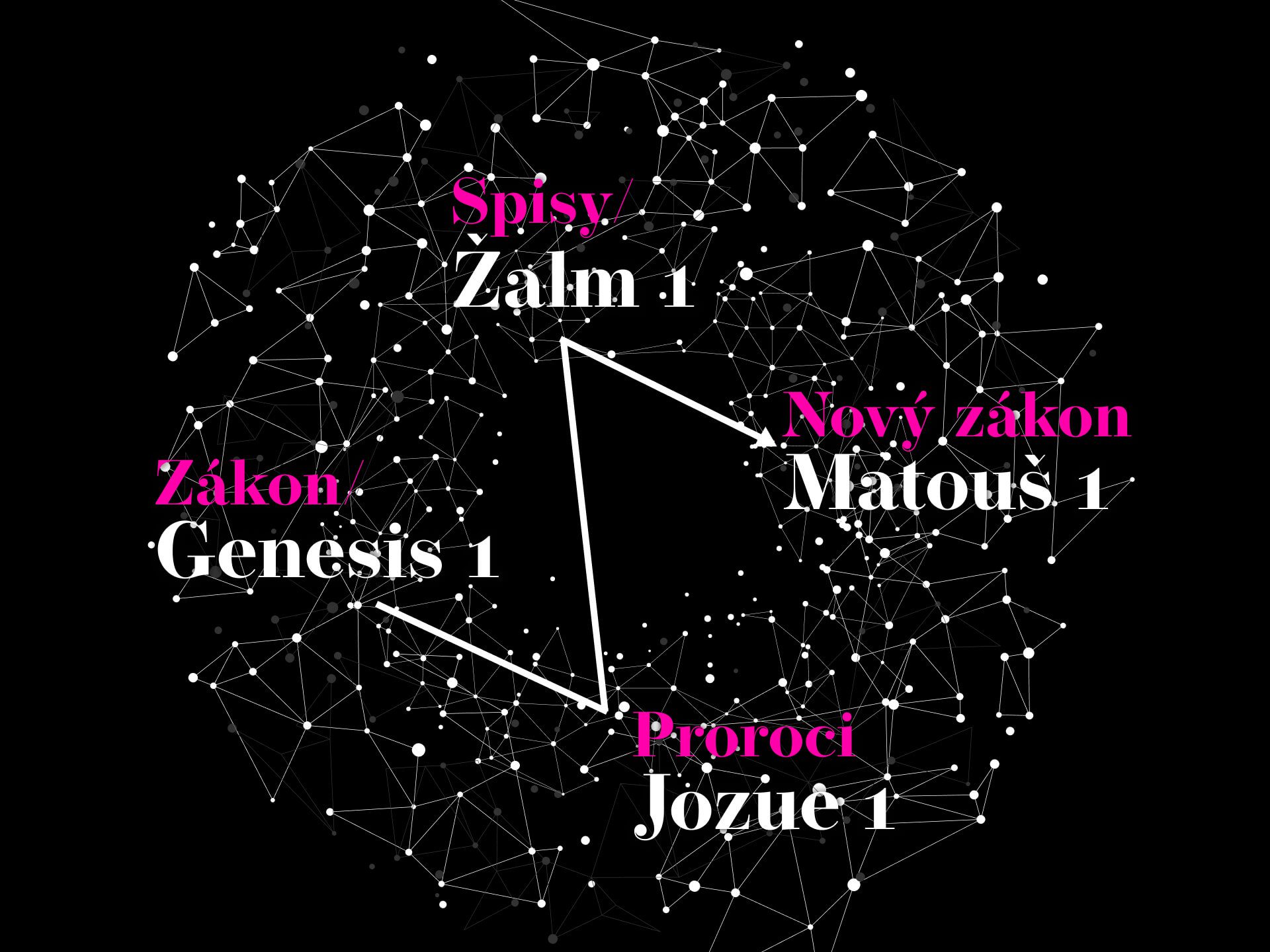
Jews divide the Old Testament into three sections: the Law, the Prophets and the Writings. Take those three volumes of the Old Testament, add the New Testament and open each of them at the first page, and you get four turning-point texts:

  • Genesis 1 — speaks to a people who have come out of slavery and, after 400 years in the fertile Nile delta, stand at the edge of the desert, left entirely to God. Genesis 1 teaches them: so what is their God like?
  • Joshua 1 — speaks to a people entering the promised land after 40 years in the desert: what should they take with them?
  • Psalm 1 — speaks to a people who have been through exile and lost the temple: their prayers become a portable temple — they recall how God has acted and carry the people when everything external has fallen.
  • Matthew 1 — speaks to a people under occupation waiting for the King to return: “the kingdom has come near” — God's reign enters the world in the person of Jesus. Matthew deliberately begins with the word genesis.

We will see whether these passages redraw the map of the world we find ourselves in. They lead us into reality as Scripture describes it.

CHAPTER 03

Genesis 1: chiasmus

A literary trick that leads to treasure

When you find a passage in Scripture where sections mirror each other in the pattern ABC–CBA (an inverted chiasmus) or ABC–ABC (a parallel chiasmus), pay attention: it is a literary device that leads to buried treasure.

Genesis 1 has both: by the length of its paragraphs it is an inverted chiasmus, by content a parallel one (3 days of separating — 3 days of filling). A chiasmus works like an arrow pointing to the centre of the story — and that is exactly where the jewel is buried. All you have to do is pace it out, or rather count the words.

And at the centre of these two chiasms stands the word for rest, mo’adim — “an appointed, sacred time, a feast”. Leviticus 23:2–3 counts the Sabbath among the mo’adim.

And that is far from all – there are more clues pointing to rest: every day has the refrain “and there was evening and there was morning” — deliberately backwards, because for a Jew the day does not begin in the morning when you wake up, but in the evening at sunset. Your day does not begin with your performance — it begins with rest. First you go to sleep, and only then comes work. On the seventh day the refrain is missing: it is as if the day never ended. It is an invitation into rest that lasts.
At the beginning of Genesis 1 there is “nothing”, and at the end there is “nothing” as well, in the form of the seventh day of rest. 

Did you expect Genesis 1 to be so soaked in the theme of rest? Why?

Genesis 1 — a double chiasm
1 · short paragraph
2 · medium-length paragraph
3 · long paragraph
4 · long paragraph
5 · medium-length paragraph
6 · short paragraph
Light and darknessday and night separated
Sky and watersthe vault divides the waters
Dry land and greeneryland and plants
Sun, moon, starslights “for appointed times”
Birds and fishfill the sky and the waters
Animals and humansfill the dry land
mo’adimsacred time · treasure

Genesis 1 — the double chiasmus, filled in. The interactive version is on the page Chiasmus: Treasure hunt.

The Bema podcast (Marty Solomon & Brent Billings) — this is where the chiasmus and the whole way of reading Genesis 1 comes from.

The Bema podcast (Marty Solomon & Brent Billings) — this is where the chiasmus and the whole way of reading Genesis 1 comes from.

STANDALONE PAGE

There is a whole interactive infographic devoted to chiasmus — including Genesis 9:6, a fill-in Genesis 1 and the conclusions about the Sabbath.

CHAPTER 04

Shalom vs. empire

Two mentalities (the Bema podcast)

Two mentalities collide here. After four centuries, the mentality of Egypt sits deep under the Israelites' skin: 

The mentality of Egypt — and of our world too 

  • your worth depends on how many bricks you make — that is the only thing that makes you worth anything to Pharaoh, and your identity rests on it; it is all about performance and usefulness
  • you have to work non-stop — provide for yourself, secure yourself, nobody will do it for you
  • a scarcity mentality: there is never enough of anything, you have to claw your way up the pyramid or you will go hungry
  • because there is not enough of anything, you are allowed to take at other people's expense — some are “expendable” (cheap labour)
  • Pharaoh never says “enough”: he builds store cities (Pithom and Rameses) and keeps piling up more. The Israelites lived in Goshen — Genesis calls that same region “the land of Rameses”, and that is exactly where the storage cities were built; and when Israel leaves, it sets out “from Rameses to Succoth” — the exodus starts straight from that city
  • as a youth leader you “have to” run the best events and be involved everywhere and in everything

Shalom — God's order 

  • your worth does not depend on what you have managed to do — you carry God's image; God loves you regardless of your performance
  • an abundance mentality: God has more than enough of everything; creation is tov me’od — “very good”
  • you are able to say “enough” — you do not have to hoard, you can rest
  • because you are provided for, you are free to give away whatever you have spare — generosity instead of competition
  • in ministry the shalom mentality means: I do not have to put on spectacular events, my worth does not rise and fall with the number of people in the room — I stand peacefully where God has placed me and try to make my ministry give the glory to him

The day of rest: how God taught a new mentality

Do you see the way God taught Israel this whole lesson? He did not just give them a clever poem with an “aha” moment — he gave them a fundamental aid for the body: one whole day of the week as a day of rest. Every week a long lesson was waiting for the Israelites, so that the new mentality would get under their skin and they would start thinking differently.

The Sabbath is therefore an act of defiance against empire (Walter Brueggemann, Sabbath as Resistance): every time you rest, you declare “I am not a slave, I am not what I produce, and the world does not rest on me.” That is exactly why rest stands at the very centre and at the goal of the poem of creation — Genesis 1 is the first blow against the narrative of Egypt.

The Sabbath in short: we rest, we play, no work, God loves us.

STANDALONE PAGE

The two mentalities (Egypt × Shalom) and the conclusions from Genesis 1 are worked out on the page Chiasmus: Treasure hunt.

CHAPTER 05

Speaking to the body

“There is always something to do. But constant work tells the heart the wrong story.”

The Bema podcast (Marty Solomon & Brent Billings)

The body has a memory of its own

When you ride a bike you do not think about it, and you really do not want to sit in a car driven by someone who has to work out which pedal to press when. In top-level sport you see a speed of reaction that thinking could never produce — those are reactions written deep into the body. You learn to ride a bike and drive a car by practice – after a while you simply “have it in your hands” and no longer have to think about it. And don't worry – it is not easily forgotten. Top-level sport is built on training too, and the body then manages a speed of automatic reactions and movements that would otherwise be unthinkable.

God built a whole curriculum on this level: he taught Israel everything in the language of the body. He designed training lessons for them, scattered through all the objects and activities of an ordinary day. 

The Jewish curriculum

  • The calendar — “In every generation a person is obliged to see themselves as if they personally had come out of Egypt” (Mishnah, Pesachim 10:5). Passover is eaten: bitter herbs = the taste of slavery on your tongue, unleavened bread = the hurry of the escape. At Sukkot you live in a booth for a week — once a year the body rehearses fragility and dependence.
  • Body, wardrobe, doorway — circumcision: the covenant written straight into the body; tzitzit — the tassels on your clothes: “you will see them and remember all the Lord's commandments”; tefillin and the mezuzah — words on your hand, between your eyes, on your doorposts.
  • The plate — kashrut: every meal whispers “you are set apart” — a small lesson in being different, three times a day. Manna: anti-Egyptian economics written into the stomach, training in trust with instant feedback — a daily portion, and a hoarded stockpile goes mouldy.
  • The temple — how do you teach someone that sin really does end in death? Picture this: I take you at the age of 13, put a young goat in your other hand and lead you into the temple — a place that hits every one of your senses the way Dune would hit someone from the 19th century. Before the killing, the worshipper lays his hand on the animal's head — a physical identification: this is happening instead of me. Your palm on warm fur, then blood, fire, smell — the lesson “sin brings death” can't be lectured any better than that. The peace offering, by contrast, is a feast with God; the temple taught both sides of reality: sin kills, and reconciliation ends at a shared table.
  • The landscape and a child's question — twelve stones from the Jordan set up as a memorial, bait for a question: “When your children ask their fathers in time to come: What do these stones mean?” (Josh 4:21)
  • A song — Deut 31: Moses is told to write a song to serve as a witness. God knows in advance that the people will be unfaithful — and the solution is a song.
God has always taught it this way

Your body has a memory of its own: on a bike you don't think about which pedal to push — and you don't want to ride in a car with someone who has to think about it. That's exactly the level at which God built the whole curriculum for Israel — he occupied the calendar, the plate, the wardrobe, the body, the door, the landscape and even a child's curiosity:

Calendarthe mo'adim occupy time
Sabbath: one whole day a week — a long weekly lesson so the new mentality gets under the skinPassover is eaten: bitter herbs = the taste of slavery on the tongue, unleavened bread = the haste of the escapeSukkot is lived in: a week in a hut, a yearly lesson in fragility — the purpose stated literally (Lev 23:43)
Platea lesson three times a day
Kashrut: every meal whispers “you are set apart” — a small lesson in being differentManna: trust training with instant feedback — a daily portion, a hoarded supply goes mouldy
Body, wardrobe, doorthe covenant within reach of the senses
Circumcision: the covenant inscribed directly into the bodyTzitzit: tassels on the garment — “you will see them and remember all the commandments”Tefillin and mezuzah: words on the hand, between the eyes, on the doorposts
Templeall the senses at once
A hand on the animal's head before the sacrifice: physical identification — “this is happening instead of me”A palm on warm fur, blood, fire, smell: “sin ends in death” can't be lectured any betterThe peace offering: reconciliation ends with a feast at a shared table with God
Landscape and a child's questiona monument as bait
12 stones from the Jordan: set up so as to provoke the question — “What do these stones mean?” (Josh 4:21)A child remembers the answer to their own question completely differently from a lecture
Songa witness in the body
Deut 31: Moses is to write a song as a witness — God knows in advance that the people will be unfaithfulA song can't be erased from the body, even when obedience is
THE PEDAGOGY OF SINAI
zakhor
Hebrew “remember” — not a mental act, but a bodily one
to remember = to act

When God “remembered” Noah or Rachel, it means: he acted. When Israel is to “remember”, it means: do.

So Sinai isn't aimed primarily at the head, but at the senses.

A slave with four hundred years of Egypt behind him can't be reprogrammed by a lecture —

he can be reprogrammed by rhythm.

God didn't give Israel better information about freedom — he gave them a schedule, a diet, a wardrobe and a song. Because slavery didn't live in their opinions, but in their bodies.

And today?

Is an approach like that primitive? Do we not need aids like these today? Hmmm… Then why did Jesus himself give us two new ones:

  • The Lord's Supper — the people brought out of Egypt remembered that act of God with the festive Passover meal. Jesus didn't throw that tradition away as something the people who have the Holy Spirit no longer need; he reshaped it into the Lord's Supper — our celebration and reminder of coming out of slavery to sin. We do this in remembrance of him. Bread is chewed, wine is swallowed — the gospel on your tongue.
  • Baptism — the body physically passes through death and resurrection: water on your skin, and the whole congregation, friends and family there with you — so that they are reminded that they have been through it themselves, or so that they have it in front of their eyes that they need it and have to think it over.

Jesus never stopped using the language of the body, and neither should we.

Dallas Willard: The Great Omission — on how we have left discipleship out of the Great Commission: training the whole person, not just passing on information.

Dallas Willard: The Great Omission — on how we have left discipleship out of the Great Commission: training the whole person, not just passing on information.

CHAPTER 06

Map of the disciplines

Nothing in life that is worth anything (a foreign language, a musical instrument, a sport) can be pulled off just by trying hard at the decisive moment; everywhere else we know that and count on training. As Dallas Willard would put it: I do today what I am capable of today, so that one day I will manage what I simply cannot manage today by trying hard — “train yourself for godliness” (1 Tim 4:7). 


What did Jesus practise that we need as well?

Disciplines of abstinence — I give something up to make room:

  • solitude — I get away from people for a longer stretch of time; I learn that the world won't collapse without me. One day a week I leave my company, “which surely hasn't a chance of getting by without me” — I put on my work clothes and work on the cottage, often with no signal. 
  • silence — I switch off the noise and the music, I learn not to scroll. I kneel down so that I can be in silence and perhaps one day catch that quiet voice. 
  • fasting — with my body I learn that “man shall not live by bread alone”. Perhaps no other discipline tells the body so clearly that my citizenship is not in the kingdom of this world. It's good to learn that when something itches you don't have to scratch — that I don't have to get everything I want.
  • frugality — living below my means; 

Disciplines of engagement — I feed on something:

  • celebration — a feast, friends, joy before God's face; Willard says that joy is the great antidote to sin — we fall into temptation exhausted, not cheered up.
  • prayer — Willard's definition: “a conversation with God about what we are doing together” — not a postbox for wishes.
  • confession — I show my failures to someone I can trust; sin loses its power once it stops being a secret, and I find out that the real me is loved, not my image.
  • submission — I let myself be led voluntarily and obey even where I don't have to; the need to always be right and in control dies — Willard counts it among the hardest.
Overview of the disciplines

Fifteen exercises in two movements of the breath: on the exhale I give something up, on the inhale I feed on something. The interactive version of the map is on the page Map of the disciplines.

DISCIPLINES OF ABSTINENCE
Exhale
I give something up to make room
DISCIPLINES OF ENGAGEMENT
Inhale
I feed on something good
solitudethe world keeps running without me
silenceI'm weaning myself off the last word
fasting“not by bread alone”
frugalityI live below my means
chastitythe other person is not a means
secrecygood without an audience
sacrificeI give out of my lack
studya mind full of Scripture
worshipproblems shrink
celebrationjoy is the antidote
servicetraining against pride
prayera conversation about our shared work
fellowshipembers keep their heat together
confessionsin loses its power
submissionI don't have to be right
MAP OF THE DISCIPLINES
Training,
not performance
I do today what I can do, so that one day I'll be able to do what I can't do today by sheer effort.
“Train yourself for godliness.” (1 Tim 4:7)

The piano

(John Ortberg:) A concert hall fills up, every seat taken. In the middle of the auditorium stand two pianos — beautiful big grands. At the first one sits a boy who spends hours playing every day; he has dozens of concerts like this behind him, so he sits down at the piano a little casually. At the second one sits a boy who has never, ever played the piano in his life, but who is determined to give everything he has in that moment. So tell me: which of them will play the piece better?

Fine — let's change the contest a bit: the first boy is not a believer, the second one is a believer and has prayed a lot to be able to play the piece well. How will the contest turn out? So why do we approach our spiritual life like that?

The disciplines will get you ready: you'll be able to become still in prayer without your thoughts flying off in all directions; temptation will come and you'll really want something, but from fasting you know very well that it will pass and in a moment you won't even miss it.

“Train yourself for godliness.”

“I strike a blow to my body and make it my slave, so that after I have preached to others I myself will not be disqualified.”

1 Tim 4:7 · 1 Cor 9:27

Training

So why do we come at ministry and the spiritual life like that second boy? The first verse has the Greek gymnaze — vocabulary from the gym. Paul trains — and Jesus trained too.

Effort doesn't cancel grace. If I made an effort in order to secure my salvation — yes, that would be a disaster, I'd be completely undermining the message of the gospel and grace. But I train my body precisely because I am already saved: I am not a slave of sin and I don't want to be one. Merit is the opposite of grace. Effort is simply sensible training.

It's 37 degrees outside and David Rajca has gone for a run. Why? Because he wants to earn salvation by running? Because his worth depends on how far he gets? No — it's simply training, and it's good for his body!

WWJD — why it doesn't work

In one respect Dallas criticizes the idea behind the WWJD bracelets (What Would Jesus Do): you simply can't stop at every moment and work out what Jesus would do — there isn't time for that. In the ring, the body reaches for what it has trained — for the reaction that is already deeply wired in. Someone comes up to you and delivers a half-funny insult to boost his own ego at your expense. A bomb of emotion goes off inside you — do you have time to ask yourself “how would Jesus react?” and to answer calmly and with love? The best result you get is a passive-aggressive smile.

Seeing Jesus and wanting to react like him off the cuff is like admiring a star footballer and wanting to play like him in a match — but without his training, his diet, his sleep and his discipline. Absurd. Yet that is exactly how we approach the spiritual life — without training — and then we're surprised the results aren't great. So is there some kind of training like the one Paul mentions? How did Jesus train?

A safeguard: don't let the Pharisees win

Ortberg: we have to measure maturity in a way that doesn't let the Pharisees win — any metric a Pharisee comes out on top of is badly designed. The Pharisees were the most disciplined, the most ceremonious and the most religiously active people of their day. Any idea of godliness that measures only outward observance, the number of spiritual activities and the keeping of rules will make them the winners — and they are precisely the people Jesus condemned. If your notion of holiness gives the Pharisees first prize, it is badly designed.

We stand on grace, but we seek God with everything we have. We long to be transformed, to be ready for every good work, to be more loving — so we train with exercises that actually make us more loving.

The Bible at home

One of the kids in my group told me: “Mum doesn't have a Bible.” It hit me that if a child has never seen their parents reading the Bible or praying at home, they get a very powerful message: in front of a group where such things are expected it's a good idea to nod along — but for private life Jesus is completely irrelevant. Whether a parent now and then holds a Bible in their hands at home is body language more eloquent than many a sermon. If parents were teaching their children that God is irrelevant to ordinary life — then a youth leader has a hard job ahead of them.

STANDALONE PAGE

All fifteen disciplines in two movements of the breath — the exhale of abstinence, the inhale of engagement — are laid out in the interactive Map of the disciplines.

Dallas Willard: The Spirit of the Disciplines — the book the map is based on.

Dallas Willard: The Spirit of the Disciplines — the book the map is based on.
TWO TALKS ON THE PHARISEES

CHAPTER 07

Psalm 1: a user's guide to being human

Blessed is the man who walks not in the counsel of the wicked,
nor stands in the way of sinners,
nor sits in the seat of scoffers.
The law of the LORD is his delight —
and on that law he meditates day and night.
He is like a tree planted by streams of water,
which yields its fruit in its season,
whose leaf never withers —
whatever he does will prosper!
But it will go differently for the wicked:
they will be like chaff that the wind drives away.

Psalm 1:1–4

Where Genesis sets out the ordering of the world and of outer reality, the Psalms describe the reality of a person's inner life: with all its emotions, joys and worries, celebrations and struggles. So if we want to understand better how a human being works on the inside, let's read the Psalms. That is the link between Genesis and the Psalms.

Even more interesting is the link between the book of Psalms and Joshua: when, after 40 years of wandering in the desert, the people are finally about to enter the promised land, Joshua takes over the leadership and the LORD himself speaks to him — and his advice sometimes sounds indistinguishable from Psalm 1.

Psalm 1 is a manual for how to read the other Psalms — but above all it is a manual for the whole human being. It answers the question: what is a genuinely good life? 

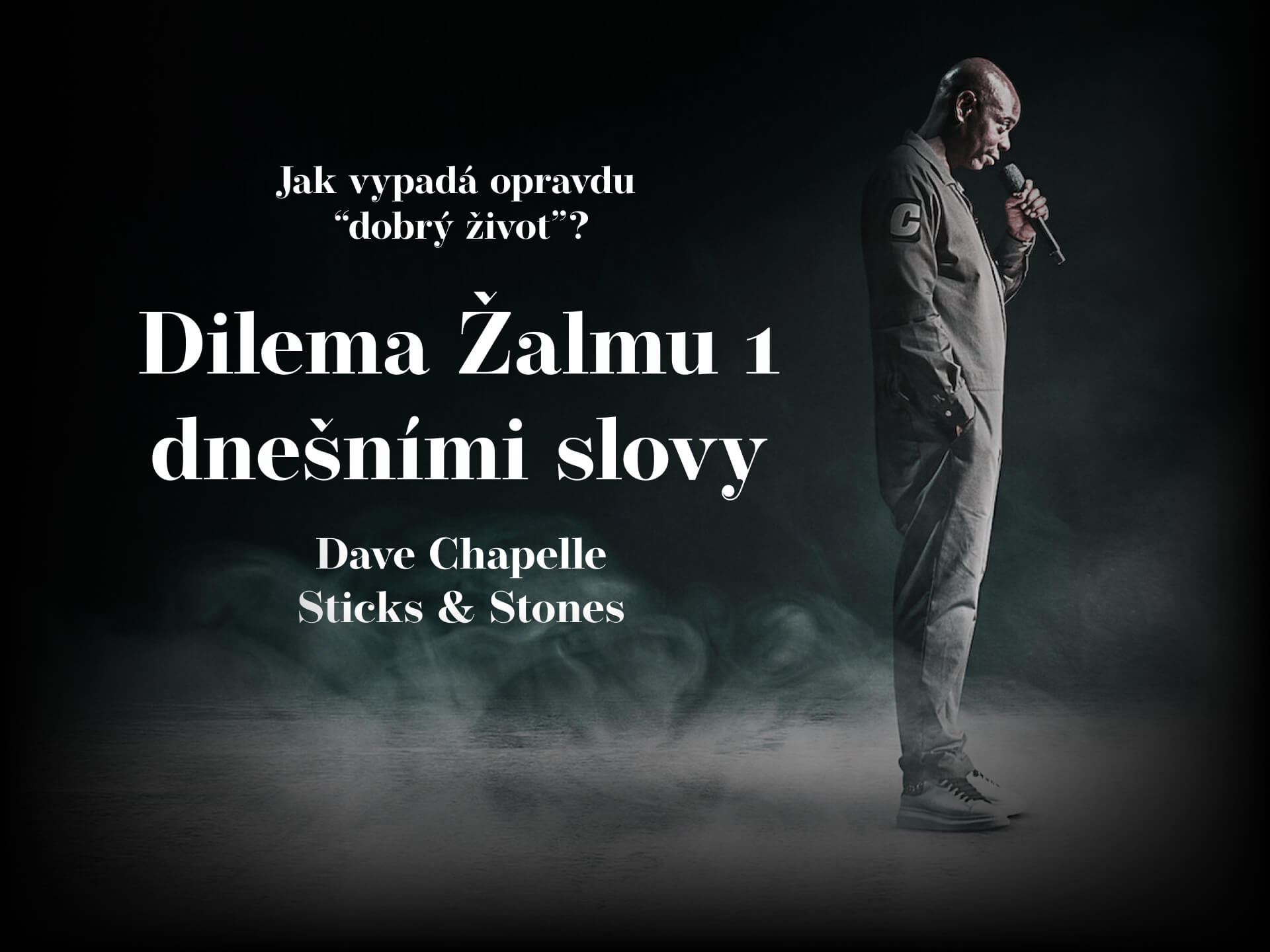
You'll say we don't need a user's guide to being human. Except that isn't quite true: our culture is in serious confusion about what a good life actually looks like. The funniest concrete example is two stories told by the American stand-up comedian Dave Chappelle.

Dave Chappelle: two stories

“Good people of Atlanta, we must never forget… that Anthony Bourdain… …committed suicide.
Anthony Bourdain had the best job show business has ever created. He flew all over the world… eating incredible food with amazing people.
And this guy… with this job… hanged himself in a luxury suite in France.”
They say two thousand zero zero Party over, oops out of time
So tonight I’m gonna party like it’s 1999 
“I knew a guy in high school who was the local genius. His grades were so good that he got out of the ghetto all the way to an Ivy League school on a full scholarship. From there he got into one of the best law schools in the country. And while he was at law school he met a beautiful woman. I told him not to rush anything, but he was in love and wasn't listening. He married her while he was still at law school, and while he was still at law school they got divorced. He was a street guy from the ghetto. That man had NOTHING… and that girl took half of it off him.
And then I didn't see him for years. Until two years ago, when I was back home in Washington, D.C., buying socks for my boys at Foot Locker. And guess who the manager was? This guy. A shop assistant dressed head to toe in a referee's uniform. He was 45, and he told me he'd been living at his mum's for the last ten years, trying to get back on his feet.
But that isn't the point of the story. The point of the story is… that it never once crossed this guy's mind to kill himself. He's alive and well in Washington, D.C… I even suggested he might want to consider it…

Dave Chappelle: Sticks and Stones

It isn't all that easy to say what a truly good, full and happy life is. How could a failed sock salesman be living a more bearable, maybe even a happier life than Anthony Bourdain? By every standard of today's culture, Bourdain's life was surely “the good life”. Why don't the usual standards work? Are there any others? What does a happy, full life look like — one you can look back on and say: “that really was a good life”? Our first Psalm answers those questions.

If people were delivered by the stork…

…they would come in a box with a little booklet titled Psalm 1 · a user's guide to being human. It would be a very pleasant unboxing, and it would be reassuring that the delivered device doesn't even need an extensive manual — six verses, that's nothing. But this tiny manual surprisingly points to a much bigger manual, one you can't read through all at once and memorise for good, which is why you have to fall in love with it and keep leafing through it.
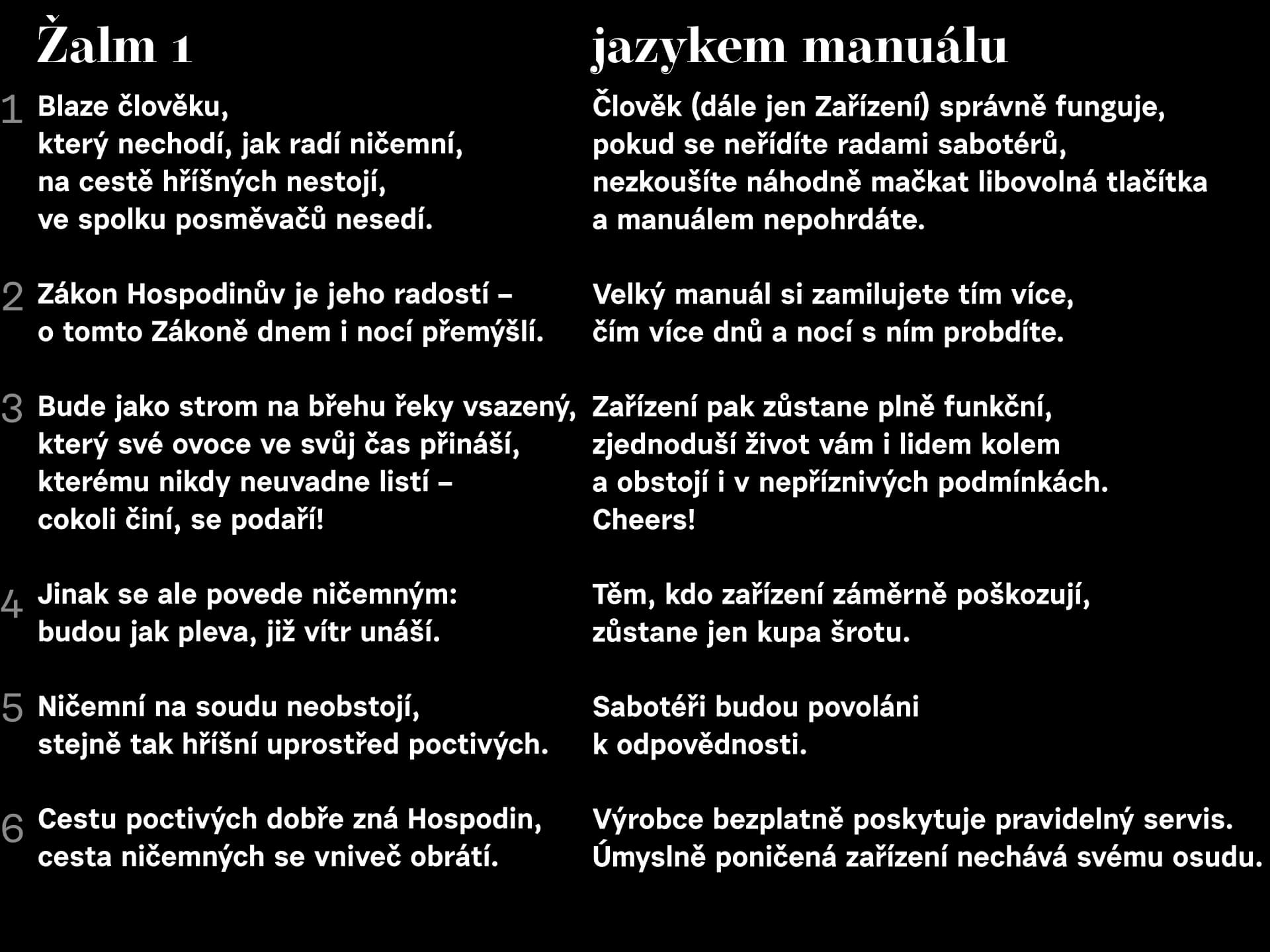
For the purposes of this illustration I have paraphrased the whole Psalm into the language of a manual:

The human being (hereinafter “the Device”) works properly
as long as you don't follow the advice of saboteurs,
don't try pressing random buttons
and don't despise the manual.

You will love the Big Manual all the more,
the more days and nights you spend awake with it.

The device will then remain fully functional,
make life easier for you and for those around you
and hold up even in adverse conditions.

Those who deliberately damage the device
will be left with nothing but a pile of scrap.

Saboteurs will be held
accountable.

The manufacturer provides regular servicing free of charge.
Deliberately wrecked devices are left to their fate.

Psalm 1 — a free paraphrase in the language of a manual

Crossroads

Psalm 1 is the key to how a human being works. If we don't go through this material properly and just improvise, the human being breaks. Just as Jesus, in the Sermon on the Mount, had in front of him wretched people in an occupied country whom he felt sorry for, and began to sketch out hope for their ordinary lives — so Psalm 1 clearly feels for its readers too, and tells them where the secret of a good life lies.

It places us at a crossroads and says: there really isn't much of a choice. There is only one road that leads to life — and if you take another one, you'll crash. God gave the world an order much as he gave it gravity: ignore gravity and you'll bloody your nose. It's the same with God's order. It isn't that “if we aren't good, God will punish us” — it's that either we're plugged into the source of life or we're not. And it makes no difference that right next to that narrow path there's a huge, comfortable motorway heading in a completely different direction, the one the vast majority of people take. But this isn't a democracy where the majority is right. The world was created by one single God, and he gave clear instructions on how you can move through life.

The stranger

The person of Psalm 1 has a clear direction — and that makes them something of a stranger, someone who stands out. Either they keep their direction, and can point to the grace everyone else needs as well — or they blend in.

The very first verse sketches how not to wander off the road: all around the person of Psalm 1 are people heading the opposite way — the Bible calls them by words that can sound like insults to us, but which in their original sense describe a direction other than the one the creator intended for his creation: “the wicked”, “the ungodly”, “the lawless”. And you can't help hearing their advice: it's there in films, in songs, on social media. The point is that none of that advice should get its hands on the rudder — that you don't start turning off course. You need to be clear about the direction: to know it, to soak it up so deeply that it runs in your veins.

“Do not be conformed to this world, but be transformed by the renewing of your mind, so that you may discern what the will of God is — what is good and acceptable and perfect.”

Rom 12:2

Two explorers

And two people come running to us off that motorway, waving at us not to go that way under any circumstances. Both of them went all the way to the end and bring back news of where the motorway leads. We know them both: one is the author of the book of Ecclesiastes, the other is Anthony Bourdain. Both lived a life of wealth, full of fantastic experiences, food and conversations — everything, in short, that is pictured on the billboards along the motorway. And both came to the same conclusion: most people never reach their ideal — and perhaps that is just as well, because those who do drive to the end fall into a sense of futility and emptiness. Only someone who wants to crash takes this motorway — Psalm 1 warns us strongly against it.

“But I have to scroll, otherwise I'll miss something!” Do you really have to watch every billboard along that other road and pump it into your bloodstream? Then you won't be any different — and you won't be able to point to a different road.

Passion and muttering

“The law of the LORD is his delight” — that first word in Hebrew is Torah, and “law” probably isn't quite the right translation: with law we associate what is and isn't allowed, and punishments. The person of Psalm 1 doesn't love a collection of statutes — Torah is God's wisdom and instruction in general; the whole of Scripture falls under it, and the whole teaching of Jesus. In Scripture the person of Psalm 1 finds direction and a source of life.

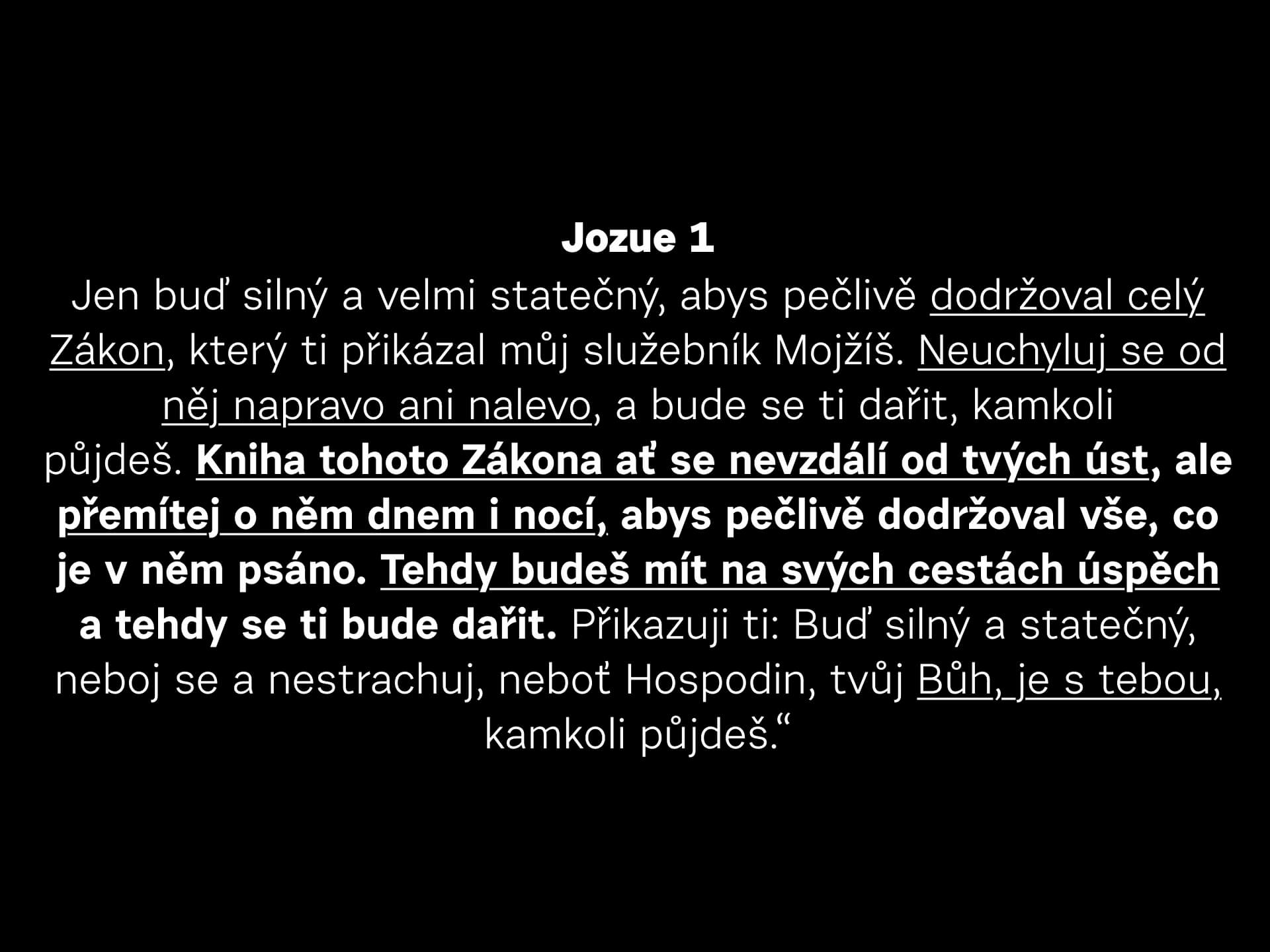
“On that law he meditates day and night” — interestingly, Joshua says: “This book of the law shall not depart from your mouth… you shall meditate on it day and night.” So is he supposed to keep speaking the word, or thinking about it? The answer is: yes. For Jews the two go together. They didn't have a Bible at home — they first heard the word read aloud and then repeated it to themselves so as to remember it. The word for meditating is hagah, muttering to yourself: reciting under your breath is the Israelite way of getting a text from the eyes into the mouth and from the mouth into the body — with the Psalms you are being fed and praying at the same time.

Detox: sit someone from the 19th century down in a cinema and play them Dune — they'd have to be carried out of the room. Not us, though, we're numbed. Or imagine the opposite: you eat a packet of sour gummy worms and straight afterwards someone takes you out for a meal aiming at a Michelin star. How did Jews experience a psalm? In a culture without images — no images anywhere, only in the temple! — a poem or a song was the most vivid thing a person ever came across. Some restriction of your media diet is therefore more than useful — so that we are able to hear that gentle voice.

How to start: it takes planning and a bit of discipline. Say a one-sentence prayer before you read · begin with Luke, for example · watch The Chosen and Bible Project alongside it · if you don't understand something, feel free to ask Claude — or better still: find someone you can send your questions to or meet up with to study · a tick sheet on the wall — a few weeks are enough to lock in the habit.

A tree, or chaff

Picture that tree: it is firmly planted by the water, so it has everything it really needs, and it isn't easily shaken. It is full of life, its leaves don't wither — it is so full of life that the life overflows into its surroundings, so that its shade and its fruit refresh everyone around it too.

And the opposite? Picture someone lying on a bed like a body without a soul — so dried up and lifeless that they don't even have enough energy for themselves and need other people to look after them. A body without a soul is actually quite an accurate comparison: chaff driven by the wind is a picture of how the grain used to be separated — when the wind blew, they scooped the grain up on a shovel, threw it into the air, and the wind carried the light stuff away. That is exactly what the Psalm compares the wicked to.

Psalm 1 is literally a matter of life and death. You are standing at a crossroads — decide right at the start which road you'll take.

A bridge into the New Testament: the Torah in person

There isn't only a written Torah — Jesus was and is a walking instruction and example of how a human being is meant to work. He alone was truly the Man of Psalm 1, with no compromises. So we don't just have to read the Torah: Jesus compares himself to the true vine — “Abide in me” — he no longer points us only to a text, but to himself as the source of life.

When Jesus was on earth, the disciples had it a little easier: they simply followed him everywhere, listened, had things explained by him, watched how he reacted and what he said. They kept close to him and imitated what he did. They were his disciples. All of that is possible even though Jesus can't be seen — he gave us his Spirit. We can still talk to him, follow him and take our individual steps and decisions to him.

Just as the tree in Psalm 1 draws on water, a Christian draws on Christ — the fruit isn't the result of effort but the consequence of staying where life flows. That is why we need to do what Brother Lawrence calls practising the presence of God — staying as close as possible.

CHAPTER 08

Matthew 4:17: the kingdom within reach

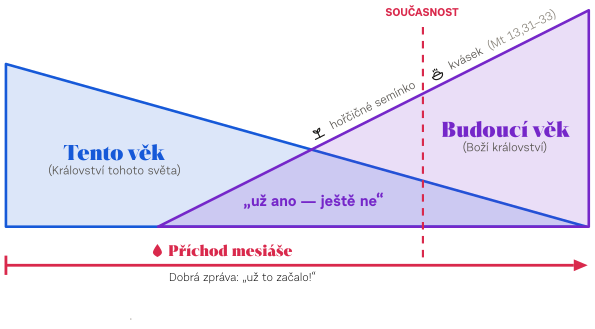
Timeline: it has already begun

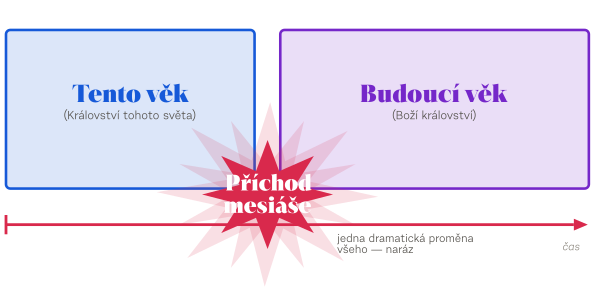
Matthew 1:1: “the book of the genesis of Jesus Christ” — Matthew reveals straight away where you are: on the first page of the new creation. And what is the King's first word in the new creation? “From that time Jesus began to preach: Repent, for the kingdom of heaven is at hand” (Matt 4:17). That is Jesus' inauguration, his manifesto — and here our key Greek word appears: metanoeite, change your thinking. What was that good news proclaimed by John the Baptist, then by Jesus, then by the disciples and now by us? That the kingdom of God is within reach. And what does that mean?
Timeline: growing through, little by little

Timeline: the Jews had two main teachings about the last times. The first expects an immediate, dramatic change when the Messiah comes — some think that is exactly what John the Baptist was expecting when he sent messengers to ask Christ: so, are you really the Messiah we're waiting for? The second is gradual — and Jesus compares the kingdom of God to a mustard seed, which is tiny but grows little by little, and to yeast that works through the whole batch of dough. The good news is: it has already begun!

Map of the good news

Map: every kingdom has its borders, and inside them the king rules — things there happen according to his will. When a king gains new territory, on paper he owns it immediately, but it takes a while before he rides across it and establishes his rule there. God's rule and will are fully in force in heaven; in the Lord's Prayer we ask that God's kingdom would spread down here to earth as well. At the very beginning of the Bible we are told of times when God's kingdom was in force where human beings lived too — and those were golden times, paradise on earth. All of history since then is the history of salvation, in which God prepares a rescue plan for humanity.

The news that the kingdom of God is within reach — to a certain extent already here on earth — really is good news, in Greek euangelion. And along with it comes “repent” — turn away from the way you have been living! There is a new King. Become his disciples, who lovingly ponder the values of God's kingdom and learn them, so that they can be his good ambassadors here on earth.

The violent and the gate

The violent are forcing their way into the kingdom

You might think the kingdom of God is an abstract idea, just right for zealots and mystics — but the opposite is true! In Matthew 11:12 Jesus looks back at how the news of the kingdom of God is spreading and says a strange sentence: “From the days of John the Baptist until now the kingdom of heaven has suffered violence, and the violent take it by force.” Who are these violent people? Can you really get into the kingdom of God by force? The same word is used in Micah 2:12–13: the flock breaks through the gate — picture the pen of a sheepfold swinging open and the sheep leaping over one another in excitement, bumping into each other as they surge out to pasture. And who was it that surged into the kingdom of God like that?

I have a picture of that gate in my head: in front of it stand zealous Pharisees who have devoted their whole lives to Scripture, and they cannot get in — they stand off to the side, indignant that a gate into the kingdom of God most certainly does not look like this; after all, they are the experts on such things. And while they stand there getting in the way, the very dregs of that society come running past them — people unclean because of illness, despised tax collectors, prostitutes — and shoulder the doors open at a run. The Gospels are full of stories like that: a paralysed man breaks a hole in the roof; a prostitute pushes her way into a respected Pharisee’s house to wash Jesus’ feet with her tears; a woman who had bled for years and by law was supposed to keep away from people forces her way through the crowd and touches Jesus’ clothes; the gate is knocked open even by the wild man from the caves and tombs whom demons had driven out of his mind. There are crowds of them!

How much knowledge and learning do you need in order to force your way into the kingdom of God? A heart full of repentance and longing for Christ — and sometimes a completely empty head. If a reporter had gone to that prostitute and given her a doctrinal interview, how many questions would she have been able to answer? Could she have said what salvation, sin, conversion, being born again, holiness or baptism are? To be a believer it is enough to know that Christ is the real thing, to go after him and to seek him — doctrine comes gradually, there is time for that. All the people mentioned above burst into the kingdom of God, and at that moment they probably knew more about Christ’s forgiveness and love than many a Pharisee: they had experienced it first-hand. With your permission I would stick the label “Christians” on them — if that label does not belong to them, then to whom?

On the one hand it is beautiful how accessible the kingdom of God can be. On the other hand it can easily happen that we have a house full of Christians and hardly anyone has any idea what the gospel is, what the good news actually is. And yet we are meant to be able to give an answer to anyone who asks.

STANDALONE PAGE

The timeline and the map of the good news are laid out in the infographic The kingdom of God: a map and a timeline.

CHAPTER 09

Climbers

Why information is not enough

John Ortberg: At one camp they had a high ropes course. Before we went up, they sat us down in the grass and explained everything: here is the rope, here are the carabiners — if you use them, it is completely safe up there. We all listened and we all believed it.

Then I climbed a rope ladder ten metres above the ground. Guess what happened? My palms did not believe it was safe up there. And neither did my armpits.

That is exactly how transformation works: I could listen to that talk about carabiners for a hundred years, repeat it and agree with it — and my body up there would still not change. Information on its own does not transform anyone; it is necessary, but it is not enough. Here is the interesting part: there were kids there who had been working that rope all summer — and they were transformed. They stood up there and their body, their palms and their armpits believed it was safe, and their minds were free to think about something else. Ours were not — up there we were gripped by anxiety, utterly predictably. And mere information would not have changed that in a hundred years.

Yet we do church as if it were enough to pour more exegesis and theology into people. We need a high ropes course for discipleship — so that, as Willard puts it, our whole body comes to believe what we believe in our heads. That is what spiritual formation and the role of the disciplines are about.

And I can be absolutely hopeless at it: one girl, frozen with terror, took an hour and a half over a route meant to last eight minutes, screaming the whole time. But she finished the whole thing. A bad disciple? Only one thing matters: if she gets on that rope every day, it is just a question of time. Transformation wins in the end. It does not matter whether you were the good one or the bad one on your first go. Only one thing matters — that you do not stop.

The stories about the piano and the ropes course, and Willard’s advice to Ortberg, all come from the Living in Christ’s Presence conference.

The stories about the piano and the ropes course, and Willard’s advice to Ortberg, all come from the Living in Christ’s Presence conference.