TALK · 2025 · PHARISEES II
Jesus shakes (the Pharisees) us
Six areas of conversation between Jesus and the Pharisees — their specks and our planks.
1 Now there was a man of the Pharisees named Nicodemus, a member of the Jewish ruling council. 2 He came to Jesus at night and said to him, “Rabbi, we know that you are a teacher who has come from God. For no one can do these signs that you do unless God is with him.” 3 Jesus answered him, “Truly, truly, I say to you, unless one is born again he cannot see the kingdom of God.” 4 Nicodemus said to him, “How can a man be born when he is old? Can he enter a second time into his mother's womb and be born?” 5 Jesus answered, “Truly, truly, I say to you, unless one is born of water and the Spirit, he cannot enter the kingdom of God. … 14 And as Moses lifted up the serpent in the wilderness, so must the Son of Man be lifted up, 15 that whoever believes in him may have eternal life. 16 For God so loved the world that he gave his only Son, that whoever believes in him should not perish but have eternal life.”
John 3:1–21 (selection)
Nicodemus
The meeting
- We've just read about a secret meeting… of two professors.
- Under cover of darkness, the highly respected Pharisee and elite professor Nicodemus comes to the country teacher Jesus — who shortly before the meeting had marched into the temple in Jerusalem, behaved, to everyone's surprise, as if the temple belonged to him, and driven out the merchants.
- But the Pharisees aren't outraged; they respond with respect. Nicodemus speaks for his colleagues: “Rabbi (Professor), we (my colleagues and I) know that you are a teacher (like us) who has come from God.” That's a very strong statement. And why are they so sure? “For no one can do these signs that you do unless God is with him.”
- Nicodemus's authority didn't shake Jesus in the slightest — on the contrary, Nicodemus suddenly becomes a pupil being taught by Jesus.
- And he tells him that for anyone who wants to experience the reality of the kingdom of God, their kind of piety isn't enough. Something supernatural has to happen — they have to be born again. Not just born the way people are born, as children of earthly fathers, but born of God.
- Jesus hits Nicodemus with such a load of questions and material packed with references to the prophets that his head must have ached for days afterwards. You have to start from scratch — be born again. Jesus went straight to the heart of the matter with Nicodemus; he even revealed to him a hint of the crucifixion and resurrection…
- I'd guess Jesus would have liked to have that kind of conversation with the others too — but many of the Pharisees he meets are nowhere near ready. Many of them first need to be shaken — he has to use the strongest language possible to wake them up.
- And it's exactly these shake-ups that we're going to look at today.
Recap: The teachers
- Last time I tried to portray the Pharisees as zealous teachers who had the lion's share in making sure the generations around Jesus knew Scripture and were looking out for the messiah. In doing so, the Pharisees were preparing the ground for Jesus.
- They wanted to teach Scripture even to the poor orphan, so that the people would stop provoking God with their disobedience. They were looking out for a rescuer, the messiah, and through their obedience they were even trying to hasten his coming. They saw the whole nation as a holy people belonging to God, as a kingdom full of priests — a calling which, thanks to Christ, belongs to us too.
Approach
- Hardly anyone probably expected that much praise for a group of people usually seen in such a negative light 🙂
- Today, in any case, we'll get to the more negative side too — but not so we can gloat over them. We'll watch how Jesus identifies the specks in their eyes, so that we, in the process, get the chance to discover the planks in our own.
- That's the procedure Jesus recommends. The general rule is as short as it gets: “Don't judge!” That's how Jesus begins his talk on the subject. “Judge not, so that you aren't judged by the same strict standard yourselves.”
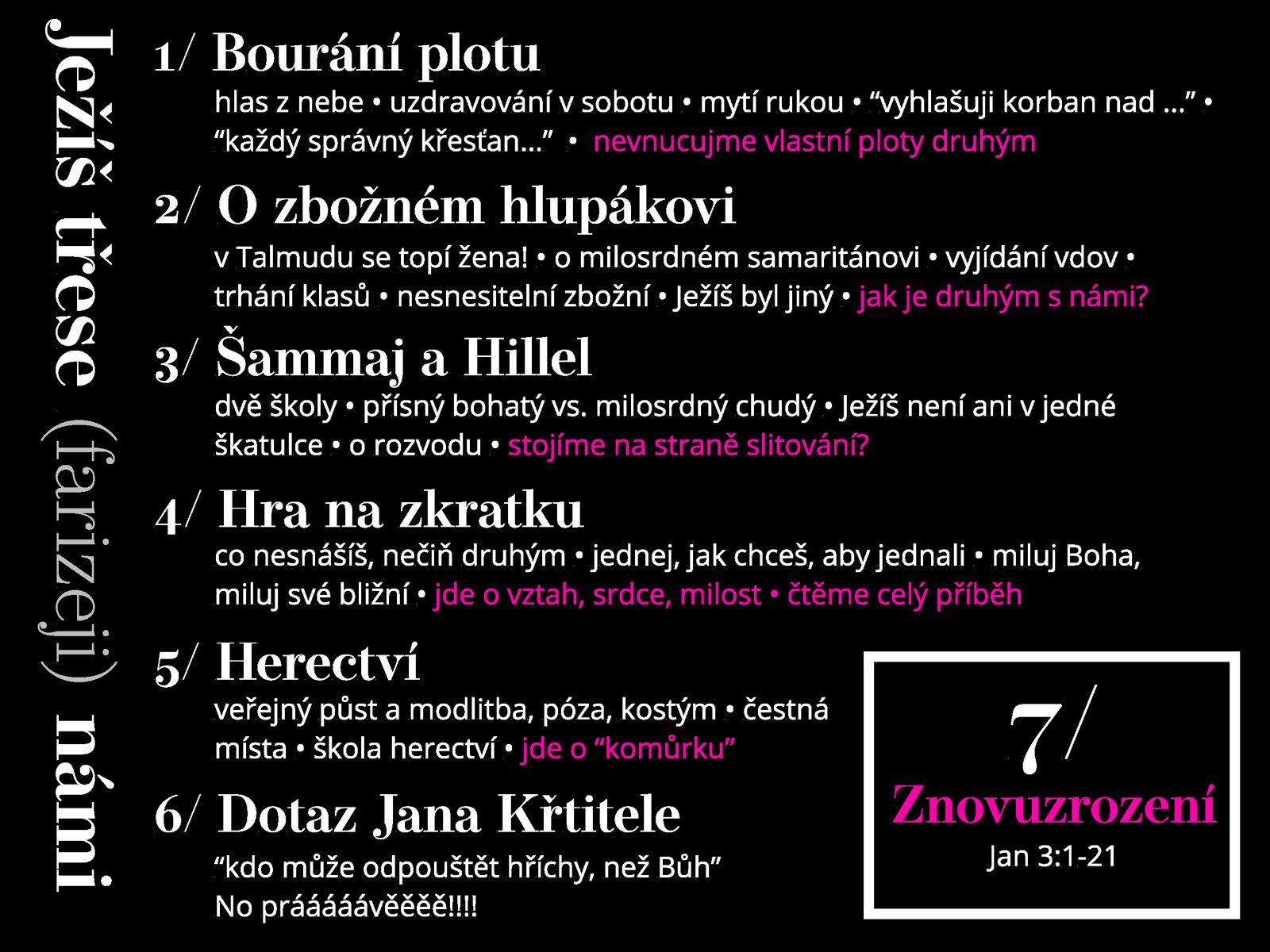
- Normally a sermon focuses on a single conversation between Jesus and the Pharisees — so I was tempted to look at an overview of all those conversations and map out the topics that come up and keep recurring.
- I've got 6 areas for you. Not 7, because I'm nowhere near having enough minutes to attempt completeness 🙂
1/ Tearing down the fence
- Rabbi Eliezer is arguing with the other rabbis about one of the laws, and even though several miracles happen in support of his interpretation, the other rabbis keep contradicting him. In the end Rabbi Eliezer says: “If the law agrees with me, let it be proven from heaven.” And a voice came out of heaven and said: “Why do you argue with Rabbi Eliezer, when the law agrees with him in all things?”
- But Rabbi Jeremiah contradicts the voice from heaven, saying: “Yes, it was God who revealed his law, but the interpretation of the law was entrusted to human beings. So not even God's own judgement can outweigh the consensus of the rabbis.” When God heard this, he began to laugh: “My sons have defeated Me, My sons have defeated Me!”
- It's a lovely, cheerful story from the Talmud — except that Jesus throws a bit of a spanner into it. He most certainly doesn't take the attitude: “what matters is how you as a group of rabbis interpret the laws, and who am I to interfere”.
- This is how it usually works with the laws: the ordinary Israelite knows that, say, the Sabbath is a day of rest — but what does that actually mean in everyday life? Interpretation is what the rabbis are there for — they discuss it and reach a certain conclusion. But to be sure the people won't overstep God's commandment, they'd rather tighten the rule a notch. And so they build a fence of their own commandments around the law itself.
- Jesus smashes into that carefully built fence around the law. He objects that the opinions of the rabbis are not on the same level as God's laws.
- Healing on the Sabbath: the rabbinic tradition of the fathers says that healing on the Sabbath is only permitted if it's a matter of saving a life — which obviously doesn't apply to a man with a withered hand. That's why the Pharisees stay silent when Jesus stands in front of them with this patient and asks them whether it's permitted to heal on the Sabbath. It's sad that they stay silent — and sadder still that not even the miracle itself softens the Pharisees.
- Washing hands: Jesus' disciples don't ceremonially wash their hands before eating — the law only requires that of priests before the rites in the temple, not of ordinary people. But the Pharisees justify it in the Mishnah: when there's no temple, even the priests might in time start neglecting the ceremonial washing of hands — so let's have the whole nation adopt this practice instead, to help the priests keep it up.
- Corban: a zealous Pharisee can declare: I pronounce this house corban — so it's set apart for God and his service. That looks wonderfully devout — except that the house was meant to provide for his parents in their old age. And yet “honour your father and mother” is a commandment in the law, while corban is merely oral tradition.
- When I was a teenager, I wrote up my own covenant with God. I set myself exactly that kind of fence when it came to girls — after all, I was a youth-group leader, and quite a few very likeable non-Christian girls came to our group, so I worked out before God where the various boundaries were. The problem would have been if I'd started forcing this on the other young people as law.
- The point for us: let's be careful whenever we push our own fences onto others as law: every proper Christian has to dress like this, read this, not watch that… Because our laws are often flawed. Jesus wasn't exactly a fan of protective fences forced on everyone.
2/ On the pious fool
- Did you know that the Pharisees wrote a book in which they criticise themselves? I think that's great 🙂 The Talmud is basically rooted in the Pharisaic tradition, and surprisingly we find in it repeated criticism of several types of Pharisee. One of them is precisely the “chasid shoteh” — the pious fool.
- According to the Talmud, the chasid shoteh sees a drowning woman, but because he suspects she's scantily clad and she isn't his wife, he can't touch her and has to guard his eyes. So he'd rather look away and let her drown.
- Does that remind you of one of Jesus' parables? Jesus tells the parable of the Good Samaritan to an expert in the law — probably a Pharisee. And in the story we have a priest and a Levite who see a beaten man but, to avoid ritual defilement, simply walk past him.
- That's the extreme where, for the sake of piety, a person is willing to sacrifice other people — or just plain common sense.
- For example, when Jesus walks through a grain field with his disciples and the disciples pick an ear, rub it in their hands to separate out the grains and eat them — the Pharisees go: aha, they're procuring food, and that's not allowed on the Sabbath! I'm parodying them a little, but only a pious fool could think that this is work.
- But this category also includes those who are so pious they're completely unbearable — scowling, obnoxious, dogged. There isn't a scrap of love for others in them. They know Scripture in depth, so that they can then beat other people over the head with it.
- Jesus wasn't like that — the most despised people in society ran to him. Remember his feast with the tax collectors? He loved them. He didn't beat anyone over the head with moralising speeches. He didn't give the woman caught in adultery a lecture — he said: neither do I condemn you — go, and sin no more.
- Now think about it, each of you for yourself: do other people feel good around you?
3/ Shammai and Hillel
- The two great Pharisees and rabbis Shammai and Hillel died when Jesus was a child. But they left behind two great Pharisaic schools that differed markedly from each other — and the Pharisees wanted to know which side Jesus leaned towards.
- Shammai came from a wealthy family and had all the time and means to study Scripture and to meet even the strictest standards of the law — he was unyielding towards others and looked down on the ordinary person.
- Hillel was a man of the people — he had experienced the hardships of the poor and was able to feel for them. When interpreting Scripture and the laws he tended towards a more merciful approach, and he accepted even those further out on the margins of society.
- So we have a clear favourite, right? Jesus was obviously a Hillelite. We can condemn Shammai as the bad Pharisee with a clear conscience. Except that, once again, it's not that simple — on the question of divorce, for instance, Jesus sided with Shammai.
- Divorce: remember when the Pharisees came to ask Jesus the burning question of the day — when is it permissible to divorce your wife? The question is framed so that he has to choose between the approach of the Hillelites and that of the Shammaites. The less strict Hillelites say that almost anything can be a legitimate reason for divorce: cold food on the table, a sullen face.
- In his answer, Jesus first recalls the ideal of the inseparable couple and adds that Moses did permit a certificate of divorce, but that was a concession because of people's hardness of heart. Above all, though, Jesus knows that in those days divorce meant disaster for a woman — an almost certain fall into poverty — and he leans towards the stricter interpretation of the law, the one that doesn't send women into poverty for no reason at all. So in this case he picks the “merciless” Shammai, who on this question is surprisingly more merciful than his colleague.
- It's not about sides, it's about compassion.
4/ The shortcut game
- Once a gentile came first to Shammai and then to Hillel with a challenge: teach me the whole Torah while I stand on one foot. Shammai, known for his strictness, turned him away. Hillel, however, famous for his patience and kindness, accepted the challenge and gave his famous reply: “What is hateful to you, do not do to another. That is the whole Torah; the rest is commentary — go and learn.”
- Jesus joined in this shortcut game too. Matthew 7:12: “So whatever you wish that others would do to you, do also to them, for this is the Law and the Prophets.” The same thing — just phrased positively and actively. It isn't about prohibitions but a call to what we should actively be doing.
- A later summary sounds a bit different (Mt 22:37–40): he began with the Shema prayer — love the Lord your God with all your heart, soul and strength (except that instead of “strength” he says “mind”) — and then goes on: love your neighbour. On these two commandments depend all the Law and the Prophets.
- So the Law and the Prophets rest on love — that's what the whole of the Law and the Prophets is about. The Psalms too. About the relationship between God and people, and between people themselves.
- And we tend to say: well yes, but unlike the old one, the New Covenant is about grace. No. The old covenant reckons with transgressions the whole time — the sacrifices are a plea to God, and the feast of Yom Kippur likewise reminds everyone that God is gracious and therefore forgives them. The old covenant is about grace too. Some Pharisee may have missed the point, but that's what it was always about — not rigid rituals without heart. Love and grace.
- Let's not throw out the Old Testament as something outdated — the New Testament grows out of it. The New Testament is like the final chapter of a book, where everything comes to a climax — but it's not a good idea to pick up a book and read only the last chapter. You'd miss the big story.
5/ Acting
- Normally, when we say hypocrisy, we mean someone who preaches water and drinks wine — who doesn't do what he tells others to do. But the word hypocritos used in Scripture means something slightly different — it comes from a Greek word meaning actor.
- And that was exactly what Jesus held against them — they were constantly putting on a show in public: when they fasted, they put on incredibly downcast faces (look how I suffer, what a hero I am); they prayed in public so that everyone could see; they walked around hunched over to show how humble they were — it was all part of the role.
- They even had costumes, like actors: “They have their prayer straps made extra wide and the tassels on their garments extra long…”
- Part of playing the hero was enjoying certain perks: “they love the places of honour at banquets and the front seats in the synagogues, they love being greeted in the streets and having people call them ‘rabbi’”.
- Part of the Pharisees' calling was to look for disciples — and at the beginning those were the eager ones who wanted to live devout lives too. But the Pharisees taught them all this acting, and in doing so they smothered the inner devotion and the love for God in them.
- Let's not act anything out — it's about the inner room. It's about what happens between us and God in secret.
6/ John the Baptist's question
- John the Baptist sent his disciples to come to Christ and ask him publicly: “So are you the one we've been waiting for? Are you the saviour all the prophets foretold?” And Jesus, in front of everyone, listed the signs that go with the Messiah and said that he fulfils them all. The bystanders must have thought: so it's true — at last someone has said out loud what was buzzing in everyone's head.
- The Pharisees did exactly the same service for Jesus when they said: “Who can forgive sins but God alone?” And everyone thought: well then — so who else is standing here in front of me but God himself! For listeners who were already wavering it was great that this remark was made — they went home with that question in their heads. They had seen a healing that confirmed who he was.
Why Jesus is so hard on them
Why did these heroes take so much criticism from Jesus?
- First of all because they deserved it 🙂 They needed someone to shake them. After all, they were the ones teaching everybody else. And James warns: not all of you should want to be teachers — you know that we will be judged more strictly.
- Teachers shouldn't put their own rules on the same level as God's laws. And they should understand that all of it is about matters of the heart, not about mechanically performing prescribed deeds.
- As teachers they had influence over crowds of people — and that is exactly why Jesus needed to give them so much attention. So that those who lead the people wouldn't be blind. Jesus works with them — much as he does with his disciples — he debates with them, he teaches them.
- Jesus was sent to the lost sheep of the house of Israel. First of all to the very last of the last in the whole society — the wounded, the poor, the troubled, the weary. But the Pharisees were lost sheep too, and Jesus tried to steer those stubborn rams in the right direction. To do that he had to use somewhat stronger words than with others, because they didn't even know they were lost.
- Actually I find it far more frightening that Jesus gives no attention to the Sadducees, who were in a much, much worse state. And it probably wasn't really possible. Jesus often debated with the Pharisees and often made them angry — but when he crossed the Sadducees, within two weeks he was hanging on a cross.
- The shaking was meant to bring them to a point where they could one day accept the main lessons — the ones Jesus talked about with Nicodemus: that Jesus has to die and be lifted up the way Moses' snake was lifted up in the desert, so that people can be saved — so that the supernatural thing can happen: that a person is born again.
Jesus shakes the Pharisees (and us) · 2025 · a loose sequel to the talk Pharisees – the teachers
More talks