Hearing God
AFTER DALLAS WILLARD · HEARING GOD
Not a vending machine for instructions, but a conversation: why God doesn't shout, the six ways he speaks, the three lights for discernment — and what to do when he is silent.
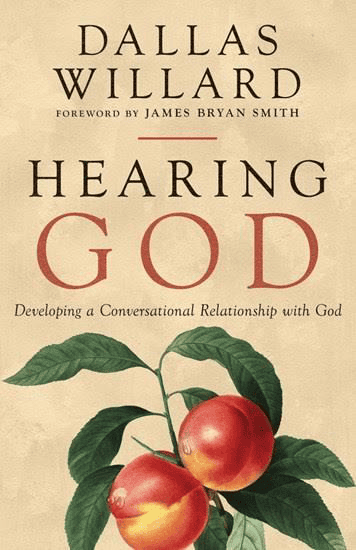
Willard's main thesis: the commonest reason we don't hear God isn't technique or noise. It's a misunderstanding about what the relationship is for in the first place. God doesn't want to be a vending machine for instructions — he is after a friendship in which people actually talk.
If all you look for is instructions, you turn God into a service window: drop in a prayer, out comes a directive. Willard warns that guidance can become an idol — and an instruction for every minute never makes anyone an adult.
That's why the book doesn't start with techniques of discernment, but with the question of what kind of relationship with God we actually want. Whoever wants only orders gets little. Whoever wants friendship will also hear the things that are easy to miss.
“The deepest reason we fail to hear God is that we neither grasp nor embrace a relationship with him that lives from conversation — and so we never grow into it.”
Jesus says the same thing: I have called you friends, because I have made known to you what I heard from the Father (John 15:15). A friend isn't a well-informed servant — a friend knows what it's all about.
If God spoke in a way you couldn't possibly miss, he would get obedience on the spot. Willard argues that this is exactly why he doesn't: a voice that steamrolls you produces a puppet. God measures his speaking so that there is room left to answer.
The spectacular ways work even on someone who doesn't know God at all. That is precisely why they are rare in Scripture and usually stand at the beginning of the journey, not at its end.
Willard's argument is simple: God respects personhood. A revelation you cannot refuse leaves no room for trust — and where disobedience is impossible, so is love.
The practical upshot: if you're waiting for a voice of thunder, you're waiting for a form God doesn't use with grown-up children. The quiet voice isn't an escape from responsibility; it's a sign that you are being treated as a partner.
That's why discernment can't be shortened. It isn't a flaw in the system — it's the condition of friendship.
Willard lists six ways and puts them in order — from the most spectacular to the quietest. They are not interchangeable versions of the same thing: the less spectacle, the more maturity it asks of you. Click on any step.
God speaks
Before I start discerning, I need to know what I'm talking about. Willard distinguishes four meanings of a single phrase — and most of the confusion comes from jumping between them without warning.
of God
The most common mistake: “God told me” in the fourth sense gets said with the authority that belongs to the third. A personal impression turns into a norm for other people — and that is exactly where devotion starts to hurt.
The opposite mistake: fear of the fourth. If you're afraid God might address you today, you end up treating Scripture as an archive. Willard wants both: a fixed text and a living voice — and a clear sense of which is which.
Two aids Willard offers instead of guesswork: line up the three lights — and test the quality, the spirit and the content of what I'm hearing. Neither is a machine for producing certainty; both are ways of not rushing.
in a single row, the
channel is safe
A captain enters the harbour channel by three lights: only when they line up in a single row is the course safe. Willard takes the image from F. B. Meyer.
Circumstances say what is actually opening up. Inner prompting says what the Spirit is laying on my heart. Scripture says what God has already said — and doesn't change.
None of those lights sets the course on its own. The commonest mistake isn't that we hear wrongly; it's that we decide by one light and overlook the other two.
When they don't line up, that isn't a signal to be brave. It's a signal to wait.
Willard doesn't treat content as the only test. He asks three things: how it sounds, what it does in me, and what it says.
The middle one is usually the most useful. God's voice leaves a person standing upright — a foreign voice either crushes them or puffs them up.
Four methods with the advantage of being fast and measurable — and the disadvantage of leaving you exactly where you were. Willard goes through them one by one.
What they share: every shortcut promises certainty without relationship. It asks only for the right procedure, not for a changed person — and so it is guaranteed to stop at technique.
That doesn't mean God never gives a sign. It means there's no point asking for one as a substitute for what he wants to do with you: turn you into someone who recognises his voice.
A practical process that pulls everything above together: four questions in a fixed order and one step at the end. Each question has its own exit — and you can't skip ahead.
At the second question. The content is usually fine (do good, call him, change jobs), but the tone pushes and hurries. That's the best signal that fear has got mixed into it.
And then at the fourth. A decision you can't take back shouldn't be made without two people who know you and have no interest in flattering you.
The last step is the smallest one. Nowhere does Willard advise waiting for a plan for your whole life. He advises doing the clear thing today — and leaving the next step for tomorrow.
Six practical steps, and what you actually get out of each one. None of them is a technique for making God speak — all of them are ways of being reachable.
A short passage a day, by heart if you like. It's not about exegesis but about a stock of words the Spirit can speak with.
God's voice starts using a vocabulary I know.
Fifteen minutes with no input: no phone, no music, no planning. Boredom is part of the exercise, not proof of failure.
I stop missing what isn't loud.
One sentence a day: what keeps coming back, what stopped me, what I did about it. After a month, read it back.
I spot the pattern — and uncover my own self-deception.
Take the smallest thing that's clear and do it today. Don't wait for big guidance while you're stalling on the small stuff.
Whoever obeys in small things is given more. This is where the “silence” most often breaks.
Tell it to two people who know you and have no interest in flattering you. Especially when it's a decision you can't take back.
I can't hear myself properly on my own. Fellowship is God's filter.
When the three lights don't line up, don't move. Waiting isn't inactivity — it's trust that God isn't running late.
It saves you the damage that pious haste does.
Willard doesn't sweep silence under the carpet and doesn't turn it into a technique. He offers four possible explanations — and only one of them would mean something is wrong on God's side.
Willard wrote for those to whom conversation with God seems the privilege of a chosen few. Surveys show how common the experience is — and how much depends on which church a person belongs to.
USA · DECEMBER 2017 · 4,729 ADULTS
I talk to God. Does God talk to me?
Almost everyone prays. The traditions differ not in who talks to God but in who says that God answers: one in four among Catholics and mainline Protestants, almost one in two among evangelicals.
USA · 2007 · 35,556 ADULTS
I receive a definite answer to a specific prayer request at least once a month
The dividing line does not run between Catholics and Protestants. Catholics, Lutherans, Orthodox and Anglicans stand close together — and well above them, Baptists and Pentecostals.
Lutherans stay low whichever wing they belong to: an answer to prayer at least once a month is reported by 27% of members of the more liberal ELCA and 31% of the conservative Missouri Synod. “Seldom or never” is the answer of 28% of Lutherans and 31% of Catholics — but only 12% of Pentecostals.
HOW TO READ THE NUMBERS
They measure what people report, not what happened — and everyone reads “God talks to me” in their own way: a thought while reading Scripture, a quiet inner voice, an audible address. Willard would say that the summit is not the burning bush but precisely that quiet voice. A low number need not mean less faith, rather a different vocabulary: someone taught that God speaks through Scripture and the sacraments will not say “God spoke to me” even after living through the very same thing. The numbers are American and cannot be transferred mechanically to the Czech setting. The mystical experience — an experience of a different kind — has its own page: Expecting God’s touch in prayer — or not?
Data sources: Pew Research Center — When Americans Say They Believe in God, What Do They Mean? (2018); U.S. Religious Landscape Survey: Religious Beliefs and Practices (2008; “at least once a month” is the sum of the answers “at least once a week” and “once or twice a month”).
“He was not in the wind… he was not in the earthquake… he was not in the fire. And after that came a still, small voice.”
Elijah expected a spectacle and got a whisper. Willard makes that the rule, not the exception: the most mature form of God's speaking is the one that is easiest to miss — and the one that steamrolls nobody.
Guidance isn't a substitute for a life with God; it's a by-product of it. Whoever looks only for instructions gets instructions — and stays a child. Whoever looks for friendship gets both.
Hence the practical upshot: discernment isn't practised on big decisions but in an ordinary day — in Scripture, in silence, in obedience in small things and among people who know me.
More infographics
 Expecting God’s touch in prayer — or not?Based on Teresa of Ávila, Lewis, Vácha and Pew surveys2×
 Prayer: The Interior CastleAfter Teresa of Ávila
 Inner prayerAfter 137 tips from Teresa to Bonhoeffer
 Models of prayerAfter Luther, Teresa of Ávila, Lewis and eighteen others2×
 Waiting with empty handsAfter Scripture and two thousand years of practice
 Prayer: The Game with MinutesAfter Frank C. Laubach
 Frequency of prayerAfter the pilgrims of the Interior Castle
 Two mentalities: Shalom vs. EmpireBased on the Bema podcast
 Chiasm: Treasure huntBased on the Bema podcast
 The kingdom of God: Map and timelineBased on the Bema podcast and MH
 Map of the disciplinesAfter Dallas Willard
 D. Willard: Renovation of the HeartBased on Renovation of the Heart
 Keller: Prayer — toil or delight?Based on the book Prayer
 C. S. Lewis on prayerBased on Letters to Malcolm
 N. T. Wright on prayerBased on the book The Lord and His Prayer
 The Minor Prophets: Twelve voicesBased on the Bema podcast
 The Gospels: Four voicesBased on the Bema podcast2×
 Straying and seekingAfter the testimonies of fourteen pilgrims
 The quiet revivalBased on The Quiet Revival2×
 T. Merton: Created for a supernatural lifeBased on The Seven Storey Mountain
 Groups of Jesus' dayBased on the Bema podcast